Categories
Articles

Wednesday’s Links

Racism, Racism, Santelli, Santelli, Acorn

Wall St. Newsletters

– Best repudiation of the “racism in America” junk we keep hearing about

– More thoughts on the “real racism”…..though it will not be popular

– Talk about timing….this summer is new contract time for Rick…Congrats

– Listen to his radio interview

– The rest of the story
Disclosure (“none” means no position):

Visit the ValuePlays Bookstore for Great Investing Books

Categories
Articles

Fairholme Funds 2008 Year End Conference Call:A Value Investors Must Read $$

Berkowitz is one of the best. He goes into to details on each of their investments. This is a must read for any value investor.

Wall St. Newsletters

Regarding Sears Holdings (SHLD):”Well, we – Eddie Lampert’s overall record is still quite deep and I don’t know you know that paper trail is important, but what’s most important to us is studying, see his balance sheet, its liquidation value. I have a whole bunch of more question on Sears that are coming a little – that – (of to an) answer and we go into a bit more detail. But we’ve always shares based upon its
liquidation values and always thought that we were buying below liquidation values and we shall see. I still believe that Sears is quite reminiscent of Berkshire Hathaway’s days with the – with Warren Buffet’s days, I should say, with the Berkshire Textile Mills and that inflection point, that point when we decided it was time to move on and reallocate the cash to more productive uses. There’s nothing I see at this point which tells me that will not happen at Sears.”

Question, can Sears pay off their debt? Can they refinance at reasonable terms?
“I think – I think the answer to both questions is yes and if Eddie Lampert has any difficulties I think he should call Fairholme cause we would be willing to help him at the right price.

There is a whole section on Sears. please read it.

Fairholme 2008 Year End Conference Call

Publish at Scribd or explore others: Wills and Trusts Business & Legal bruce berkowitz fair

Disclosure (“none” means no position):Long SHLD

Visit the ValuePlays Bookstore for Great Investing Books

Categories
Articles

"Davidson": Traders Rule the Moment

He has a very valid point, there is no talk of valuation out there currently. That both creates tremendous markets swings and for the patient of us, tremendous opportunity.,

Wall St. Newsletters

I thought that these charts (below) told the story of the credit freeze. I think the Traders rule at the moment. Valuation for the moment does not carry much weight. The forecasted earnings yield of ~8.6% 12mo forward for SP500 seems to stimulate some to forecast worse earnings than this in order to get their 20 secs on CNBC. I interpret these charts to indicate that it appears that earnings are forecasted to be well below the long term trend. I do have a chart that takes the earnings trend back to the late ‘40’s with what appears to be the same variance within the same channel at ~6% compounded for the entire period. Today forecasts are well out side the historical range.

To get a similar collapse of valuations in the past required a high rate of inflation, 1974 and 1982 both had 7 P/E’s and 12%-14% earnings yield range. This was required. I have observed that since 1978 when we have reasonably good data that the market requires a return that provides just over 3% Real Rate of Return. In 1982 with core inflation (see Dallas Fed trimmed mean PCE data 1982 inflation at ~9%-11% + ~3% Real Rate of Return = 12%-14%) in the 11%-12% range the SP500 earnings yield was in the 12%-14% range.

Over the past few months 12mos forward earnings yields have ranged over 11% to the current ~8.6%. The market appears to be pricing inflation in the next few years at the 5.5%-8% range or a period of earnings well below that which has been in place since the 1940’s.

I cannot forecast the future any better than the many professionals who are paid handsomely to do this. But, I do not think our national productivity, our willingness to work our desire put our kids through school and our general improvement of our condition has not changed from last year to this. My view is that the SP500 which represents some 90%+ of US public companies mirrors the results of these efforts. We can measure this with some certainty since the ‘40’s. We have certainly had many issues along the way. We have always recovered.

Disclosure (“none” means no position):

Visit the ValuePlays Bookstore for Great Investing Books

Categories
Articles

General Growth Properties Files 8-K: A Look Through $$

A closer look reveals things are far better than the market assumes and for those who enjoy irony, the “worse case scenario”, may actually be the best….

Wall St. Newsletters

General Growth (GGP) currently has ownership interest in, or management responsibility for, over 200 regional shopping malls in 44 states, as well as ownership in master planned community developments and commercial office buildings. The Company’s portfolio totals approximately 200 million square feet of retail space and includes over 24,000 retail stores nationwide.

Results from the Press Release:

Chicago, Illinois, February 23, 2009 — General Growth Properties, Inc. (NYSE: GGP) (the Company) announced today its results of operations for the fourth quarter of 2008. Core Funds From Operations (Core FFO) per fully diluted share for the fourth quarter of 2008 were $0.72, Funds From Operations (FFO) per fully diluted share were $0.70 and Earnings per share — diluted (EPS) were zero. For the full year 2008 Core FFO was $2.83, FFO was $2.72 and EPS was $0.10. Although FFO per fully diluted share for the fourth quarter of 2008 increased from the $0.64 of FFO per fully diluted share for the fourth quarter of 2007, both Core FFO and EPS declined in the fourth quarter of 2008, as compared to the fourth quarter of 2007. Both the quarterly and annual 2008 and 2007 comparable periods had significant items that affected FFO comparability, including provisions for impairment, tax restructuring benefit and strategic review costs. A supplemental schedule showing such items and their impact on 2008 and 2007 FFO is provided with this release.

FINANCIAL AND OPERATIONAL HIGHLIGHTS
• Core FFO is defined as Funds From Operations excluding the Real Estate Property Net Operating Income (NOI) from the Master Planned Communities segment and the (provision for) benefit from income taxes. Core FFO for the fourth quarter of 2008 was $231.0 million, or $0.72 per fully diluted share, as compared to $271.2 million, or $0.92 per fully diluted share, for the fourth quarter of 2007. While the aggregate of minimum rents and tenant recoveries remained essentially flat for the quarter, overall declines in the general economy, and the retail market specifically, impacted our retail properties causing revenue reductions in overage rents, and other income (for items including promotion, sponsorship, and parking income). Cost reductions in marketing, repairs and maintenance, supplies, contracted services, security, landscaping, and personnel costs, did not fully offset our revenue declines.

• FFO was $222.2 million in the fourth quarter of 2008 as compared to $190.4 million in the fourth quarter of 2007, an increase of approximately $31.8 million. FFO was significantly impacted by items as detailed in the attached supplemental schedule. Excluding such items, FFO declined in the fourth quarter of 2008 as compared to the fourth quarter of 2007 as a result of lower comparable NOI in the retail and other segment and higher interest expense.

• EPS were zero in the fourth quarter of 2008 compared to $0.24 in the fourth quarter of 2007, substantially all of which was due to the items listed in the attached supplemental schedule and the matters affecting Core FFO and FFO described above.

2009 Maturing debt and liquidity concerns

We are primarily focused on our near and intermediate term loan maturities. The refinancing market remains at a standstill. We are considering all strategic alternatives and are continuing our discussions with our lenders. In addition, we have suspended our cash dividend, halted or slowed nearly all of our development and redevelopment projects, systematically engaged in certain cost reduction or efficiency programs, reduced our workforce by over 20% and sold certain non-mall assets. We currently have approximately $1.179 billion of past due debt and approximately $4.09 billion of debt that could be accelerated. However, our lenders have not yet exercised any of their remedy rights with respect to such debt. In addition, we have $1.44 billion of consolidated mortgage debt and approximately $595 million of unsecured bonds scheduled to mature in the balance of 2009 that remains to be refinanced, repaid or extended. In the event that we are unable to extend or refinance our near and intermediate term loan maturities, we may be required to seek legal protection from our creditors.

Given the uncertainties concerning our ability to refinance maturing loans and the impact of potential strategic alternatives, we will not provide Core FFO guidance for 2009 at this time.

Here is the debt maturity schedule:

Debt Covenant Ratios:

SEGMENT RESULTS

Retail and Other Segment
• NOI declined 2.4% from the $718.9 million reported for the fourth quarter of 2007 to $701.8 million for the fourth quarter of 2008. This reduction in NOI is primarily due to decreased revenue primarily due to declines in overage rents and other income.

• Comparable NOI from consolidated properties decreased 4.1% in the fourth quarter of 2008 versus the fourth quarter of 2007.

• Comparable NOI from unconsolidated properties at the Company’s ownership share for the fourth quarter of 2008 declined by approximately 10.0% compared to the fourth quarter of 2007. Declines in termination income in 2008 (due to certain individually large terminations in 2007) and foreign currency translation rate differences between periods caused the comparable NOI decline for unconsolidated properties to be significantly larger than that of the comparable consolidated properties.

• Revenues from consolidated properties declined approximately 3.2% for the fourth quarter of 2008, or approximately $27.5 million, to $840.5 million as compared to $868.0 million for the same period in 2007 primarily due to declines in overage rent and other income.

• Revenues from unconsolidated properties at the Company’s ownership share declined slightly for the fourth quarter 2008 as compared to the fourth quarter of 2007, to $162.2 million from $163.2 million, as increased minimum rents from certain expansions and renovations opened since late 2007 and certain ownership increases in properties owned through our international joint ventures were more than offset by overage and other income declines across the segment.

• Comparable tenant sales, on a trailing twelve month basis, decreased 3.8% compared to the same period last year.

• Sales per square foot, on a trailing twelve month basis, decreased 4.2% compared to the same period last year.

• Retail Center occupancy decreased to 92.5% at December 31, 2008 from 93.8% at December 31, 2007.

Now much has been said about the property that GGP holds and how it has deteriorated in value. BUT, if we look at recent land sales from their planned communities, we see the opposite is happening:

Here are the top ten tenants in Retail Operations:

None of these large tenants are in danger of leaving avoid in a Chapter 11 proceeding. GGP derives 60% of rents from anchor stores and 40% from the remainder.

Breakdown by region:

So, no two ways around it. The debt is crushing them but operations are performing just fine, very well actually given the current climate. Also, the value of the real estate on the books is clearly below it actual value. The more one looks at it, one has to hope they file Chapter 11, clear the debt and start over.

The opportunity here is really impressive…

Disclosure (“none” means no position):Long GGP

Visit the ValuePlays Bookstore for Great Investing Books
Categories
Articles

"The Big Rich"

This is very interesting. From the author of the classic “Barbarian’s at the Gate”. I have not read this work yet, but based on past efforts, I am sure it is more than readable.

Wall St. Newsletters

Here are the books:

Here is the author talking about his latest work:

Disclosure (“none” means no position):

Visit the ValuePlays Bookstore for Great Investing Books

Categories
Articles

Tuesday’s Links

Bailout mascot, Geithner & Summers, Banks, Banks

Wall St. Newsletters

Classic

Sad and true

– Insider are buying

– Cheap as tech stocks were after the crash?
Disclosure (“none” means no position):

Visit the ValuePlays Bookstore for Great Investing Books

Categories
Articles

General Growth Properties: A Look at Real Estate Values $$

I am buying shares of General Growth Properties (GGP) today as I feel there is deep value in them.

Wall St. Newsletters

Where is the value? General Growth is a U.S. based, publicly traded Real Estate Investment Trust. The Company currently has an ownership interest in or management responsibility for a portfolio of more than 200 regional shopping malls in 44 states, as well as ownership in master planned community developments and commercial office buildings. The Company portfolio totals approximately 200 million square feet of retail space and includes over 24,000 retail stores nationwide. The Company is listed on the New York Stock Exchange under the symbol “GGP”. For more information, visit the Company Web site at www.ggp.com.

GGP carries it’s real state holding at cost and according to its 2007 annual report, the total is $28 billion. If we take the 200 million sq. feet of retail space they have, the cost basis is $140 a sq. foot.

Now, let’s look at the MIT Transaction based cost index for the 2008 year. This matters because it takes into account what sold for what, not an estimated value.

Retail Current Cost
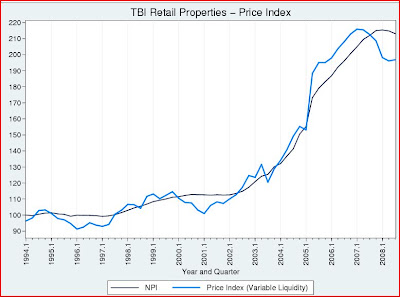
Using the $195 a sq. foot price from MIT, we get a real estate value for GGP of $39 billion. GGP has a current market cap of $115 million meaning it sells for .3% of its real estate value, that is point 3% not 3%. With $27 billion of debt outstanding and due in 4 years, if we subtract that from the current property value there is still $12 billion or $36 a share of value left in the properties (based on 331 million shares outstanding as of last 8K). Now, of course the actual amount will vary depending on what properties are sold where but we have a good indication by using national numbers because GGP does have holdings nationally.

To further boost a valuation, we can look at the age of the properties. Starting on F-61 of the above linked annual report we see that only $3 billion of the $28 billion total has been acquired since 2007. These properties one could argue were purchased at inflated prices and perhaps worth only equal too or slightly below carrying cost. The majority of the properties are 2002 and earlier giving a large boost to the “carry coast being far less than market value” theory.

Perhaps this is why Bill Ackman has taken a stake in 25% of the company.

The Loans:

On Feb. 12th GGP said:

On February 13, 2009, General Growth Properties, Inc. (the “Company”) and certain of its subsidiaries, including Oakwood Shopping Center Limited Partnership (collectively with the Company, the “Company Parties”), Citicorp North America, Inc., as a lender and as administrative agent for the other lenders party thereto, and certain additional lenders (collectively, the “Lenders”), entered into a First Amendment to Loan Agreement (the “Amendment”) which amended the Loan Agreement dated as of January 30, 2006 by and among the Company Parties and the Lenders for the mortgage loan secured by the Company’s Oakwood Shopping Center located in Gretna Louisiana (the “Loan”). Pursuant and subject to the terms of the Amendment, the maturity date of the Loan was extended to March 16, 2009. The Loan’s original maturity date of February 9, 2009 had previously been extended pursuant to agreements between the Company Parties and the Lenders.

The Company is currently in default under certain of its loans. As previously announced, the Company has entered into forbearance agreements with certain of its lenders pursuant to which such lenders have agreed to forbear from exercising certain of their default related rights and remedies under such loans. However, the forbearance agreements related to mortgage loans secured by the Company’s Fashion Show and Palazzo shopping centers located in Las Vegas, Nevada expired on February 12, 2009. The expiration of these forbearance agreements permitted the lenders under the Company’s 2006 Credit Facility and 2008 secured portfolio facility to terminate the previously announced forbearance agreements related to these loan facilities. However, the Company has not received notice of any such termination, as required by the terms of such forbearance agreements. In addition, the Company has also been unable to enter into or extend forbearance or similar agreements for its other mature secured mortgage loans, and there can be no assurance that it will be able to do so. The Company continues to work with its lenders with respect to loans under which it is in default or may be in default in the near future.

What does it all mean. Simply, even if GGP were forced into bankruptcy, the actual value of it exceeds the debt meaning there is still large value for shareholders. At $.43 cents a share, the upside is stunning and the downside is limited to your investment, $.43 cents.

What will the lenders do? Think about it. Do the lenders really want to start writing down commercial real estate loans for one of the largest property owners in the US by forcing it into bankruptcy? No. Why? In our “mark to market” world we now live in, this would mean that debt on other strapped REIT’s would then have to be “marked down” also causing more billion dollar losses for banks. Not good.

This is the reason for the various debt extensions for GGP.

Earnings come out today after being delayed for two weeks. One has to expect some news to accompany them. I am buying shares ahead of it

Disclosure (“none” means no position):Long GGP

Visit the ValuePlays Bookstore for Great Investing Books

Categories
Articles

Monday’s Links

Santelli, Don Harrold on Rick, MSNBC, Hardball

Wall St. Newsletters

– After being attacked by the White House

– Another take on it

– Shock!!! MSNBC atacks anyone who questions Obama policy…SHOCK

– Barnacle makes Matthews irrelevant

Disclosure (“none” means no position):

Visit the ValuePlays Bookstore for Great Investing Books

Categories
Articles

Judge Rules Haas Family to be Deposed

Dow Chemical (DOW) won a ruling in court Friday vs Rohm & Haas (ROH).

Wall St. Newsletters

Dow Chemical / Rohm & Haas Depositions

Publish at Scribd or explore others: Court Filings Business & Legal dow chemical rohm ha

My take on this is Dow will attempt to get the founding family on record saying they wished for the combined entity to survive. If Dow can then cast doubt on that should the merger be forced immediately, then they now have a huge continent of shareholders in essence wanting the merger to be delayed (not canceled).

Either way, it will be interesting..

Disclosure (“none” means no position):Long DOW

Visit the ValuePlays Bookstore for Great Investing Books

Categories
Articles

"Davidson": Thoughts on "Fair" vs "Free" Markets

Davidson has a very thoughtful pieces on markets, the government’s roles, investors and traders vs value investors.

Wall St. Newsletters

Under the Bush Administration it would appear that “Fair Markets” which was the theme of Securities Act of 1934 and other responses to the events that produced the Great Depression became “Free Markets”. Free Markets which have little restraint become dominated by the avarice of the marginal investors who are bright enough to skirt all the laws then enforced to take undo advantage of all other investors who being responsible and in the view of these few operate within the doctrine of “Fairness”. The “Free Market” syndrome simply missed the fact that there are always individuals who will “game” the system and because they have greater resources manipulate markets for their own advantage knowing that most will follow a sense of “Fairness”. These few are not stupid people. They are very bright. Bright enough to understand the system, see its flaws and acquire the means by which to enrich themselves at the expense of others who believe in the concept of “Fairness” as originally conceived.

It would appear the April 28, 2004 SEC regulatory meeting much discussed today at which investment banks were freed to lever up to 40-50X was simply part of a general belief that “Free Markets” self-correct and self-monitor. Unfortunately what was missed is that this is only possible in a medium of complete and utter transparency. In fact, while we gradually forced Warren Buffett to expose his holdings thus taking away some of his freedom to move about the market place, we gave HF’s invisibility. We also gave these folks invisibility as to the new securities contracts they created with the incredibly wrong belief that they would self-monitor. Many including Alan Greenspan supported this construct.

“Free Markets” will never be completely transparent as individuals will always find a means to game the system dishonestly. This is why rules are necessary to make markets “Fair Markets” to all with the individual investors who are the fundamental base of all investing through their daily effort, their labor and creativity, to produce GDP. We lose sight that our economy and the stock and bond markets rest on the efforts of people earning a living. We lose sight of the fact that the investment markets are not a world unto themselves that can be mathematically analyzed and thrown in to formulas by which to create wealth. The investment markets are simply a representation of the productivity of our society. I like to think of the markets as a console full of dials. It simply measures the results of all the inputs to society as it pertains to our productivity. The markets reflect our hopes, our generosity, our legal system and our political system. The markets reflect our entire value system and how we organize our efforts to self improve.

Markets need to be “Fair” not “Free”. Transparency of every contract, every levered position, every trade and every association of one contract holder with another should be paramount. If there is an ability of one investor to gain advantage over another with secrecy, then there should be rules that forces this into the light of day so that we can determine if it is “Fair to Individual Investors”.

There should also be a “Recourse Rule”. If you buy a house today it is non-recourse to the buyer. It is up to the bank to have performed the underwriting to the level that assures safety of principle and interest. This lets single buyers own multiple homes to speculate without personal risk. We are all suffering today from the fallout of housing speculators who have walked away from recent transactions leaving our financial institutions with the losses. All obligations should carry some form of recourse to the parties involved. It would add personal risk to speculation and reduce the risk to us all. How this can be done regarding investment contracts and investment firms can be left up to them to develop a fair solution. The concept is that there should be some recourse to the individual who created the contract till the contract has terminated.

“Fairness” should be the rule-personal responsibility of behavior should be the goal. “Free Markets” leads to avoidance of responsibility. I liked Pres. Bush, but he simply got it wrong. This mess will be his legacy.

We have Traders and Value Investors. The former believes that price accounts for all information, Efficient Mkt Hypothesis. The latter believe in understanding a business and buy with cash flow, Owner’s Earnings and etc.

First, the Traders support Mark-to-Market while the Value Investors scream that it is a bogus benchmark. The Traders sell stock and if it goes down they say, “See!! If it goes down, it was meant to go down to find its real “value”!!” It is an amazing set of mental gymnastics that Traders use to convince themselves that “emotional pricing” of securities represents a valid method of “fair value accounting” for which Mark-to-Market was designed to effect.

Second, there are many, many more Traders with their simplistic approach and strong self belief/confidence than there are true Value Investors. It is easy to see that Value Investors do not by their selling create tops nor by their buying create bottoms. It appears to be more a factor that Traders simply exhausted their fire power. Where this level is I do not know. Unfortunately, “Mark-to-Market” is a destructive feed-back device. It supports erroneous contention reinforcing it’s own effect. It goes in the wrong direction till you reach such a silly level that eventually some percentage of Traders see the folly and an apparent “Value” becomes obvious. The snap back becomes very sharp.

I don’t know where that level is. Obviously this past week was not that level.

Disclosure (“none” means no position):

Visit the ValuePlays Bookstore for Great Investing Books

Categories
Articles

Greenspan, Paulson & Co, and PIMCO

My disdain for our former Fed Chair grows daily..

Wall St. Newsletters

Found this interesting post this morning.

By Mark Mitchell, Published: February 21st, 2009 9:44 PM EST

Charles Gasparino, the CNBC reporter, published an op-ed in The New York Post yesterday.

Here’s a part of what he had to say:

Earlier this year, high-flying hedge fund Paulson & Co. retained [former Federal Reserve chief Alan Greenspan] for its “advisory board.” The firm is a noted “short seller” of banks and financial stocks – meaning it makes money when these companies’ shares fall.

The thing is, Greenspan is making public comments that inevitably influence public policy and the markets – and some of those comments may well have led to his clients making a nice profit.

In a recent speech to the Economic Club of New York, Greenspan said the recession would likely “be the longest and deepest” since the Great Depression and that Congress might have to allocate more money to save the beleaguered banking system on top of the billions already gone for the Troubled Asset Recovery Program.

Then he told the Financial Times: “It may be necessary to temporarily nationalize some banks in order to facilitate a swift and orderly restructuring” of their troubled balance sheets.

Such a move would wipe out stockholders, sending shares of banks even lower – thus likely benefiting Paulson. It would also protect bondholders, helping another Greenspan client, the large bond-firm Pimco.

The question is: Why didn’t Gasparino, or anybody else, say this on CNBC?

Hedge fund manager Paul Kedrosky appeared on the network to criticize Greenspan’s relationship with Pimco, but there was no mention of the former Fed chairman spewing negativity for Paulson’s short selling operation.

More importantly, no proper journalist at CNBC has reported that short sellers use many other tactics (such as planting false stories on CNBC and manufacturing phantom stock) to demolish public companies and crush the markets.

At our nation’s leading business network, only Jim Cramer reports on this scandal. Only Jim Cramer tells America about one of the most important causes of the worst financial crisis since the 1930s.

He does so with funny sound effects while prancing around the Romper Room set of a program that is called “Mad Money.”

These days are surreal, to say the least.

Now, I’m all for free speech like the next guy. I am also for full disclosure. If Greenspan is going to give a speech on the economy, he must be required to tell us the negativity he is espousing directly benefits his clients.

He already did the historical revisionist thing last year when his book came out. He attempted to put a nice face on the mess he left Ben Bernanke with. Folks did not buy it.

Now Greenspan, “the advisor” is giving speeches as the “former Chairman of the Fed” and the opinions he is giving just happen to parrot those of his clients.

Can anyone get him to be the least bit honest….anyone??

Disclosure (“none” means no position):

Visit the ValuePlays Bookstore for Great Investing Books

Categories
Articles

Sunday Humor……

This site is so funny I had tears coming down my face. I think we could all use a laugh now..

Wall St. Newsletters

It is called F$%& My Life

Disclosure (“none” means no position):

Visit the ValuePlays Bookstore for Great Investing Books

Categories
Articles

Saturday Reading- All About Bailout

Auto’s, Mortgages, Stim broken down, Ross

Wall St. Newsletters

– Bull, let them go

Duh

– The big “rip off”

A buyer?
Disclosure (“none” means no position):

Visit the ValuePlays Bookstore for Great Investing Books

Categories
Articles

Hotchkis & Wiley Releases Misleading Press Release About Their Holdings in Dow Chemical & Rohm & Haas

When I first read this press release, I was left wondering what I was missing. How could Hotchkis & Wiley, as a Dow shareholder as intimated in this letter want a merger now? So I did some digging and guess what I found?

Wall St. Newsletters

Here is the press release:

LOS ANGELES–(BUSINESS WIRE)–Hotchkis and Wiley Capital Management
today announced the firm has contacted Rohm and Haas Company (NYSE:ROH –
News) to express support for the closing of the acquisition of Rohm and
Haas by The Dow Chemical Company (NYSE: DOW – News) under the
contractual terms of a definitive agreement entered by Dow and Rohm and
Haas on July 10, 2008.
A large shareholder of Rohm and Haas, Hotchkis and Wiley addressed CEO
and chairman Rajiv Gupta in the following letter today:

Mr. Rajiv L Gupta
CEO and Chairman of the Board
Rohm and Haas Company
100 Independence Mall West
Philadelphia, PA 19106

Dear Mr. Gupta,

We are writing to express Hotchkis and Wiley’s support for your efforts
to close the Dow Chemical transaction on its contractual terms. As a
recent top ten shareholder of Dow Chemical and current large shareholder
of Rohm and Haas, we are intimately familiar with the assets of both
companies. Additionally, we have undertaken a thorough analysis of the
merger agreement and Dow Chemical’s ability to finance this transaction.

Regarding the merger agreement, our conclusion is that specific
performance is warranted. We view the contract as strong and unlikely to
be improved. It is our view that Dow Chemical should honor their
commitment. However, in the event that the agreement continues to be
breached, we want to affirm your resolve to seek specific performance
along the original terms laid out in the contract. Any change to the
original contract would merely expose shareholders of Rohm and Haas to
unnecessary risks.

Dow has a variety of options available to honor the agreement on its
original terms. These options include drawing down the bridge loan,
divesting certain assets, obtaining long-term debt financing and issuing
equity. While the current financial crisis has made financing terms less
favorable than they have been in the past, options are nevertheless
available. Any one or combination of these options would provide the
capital needed to close the transaction.

The most obvious solution for Dow Chemical is to undertake an equity
offering. This option has been available to Dow since the signing of the
agreement and continues to be available today. We believe that the
current uncertainty regarding the transaction has obscured the value of
the combined entity. We have expressed to Dow Chemical our interest in
participating in an equity offering to accommodate the transaction.

Hotchkis and Wiley has a 28 year history of investing in US equity
markets. As of December 31, 2008, we managed $10.8 billion in client
assets. We look forward to being of any help possible. Please contact me
with any questions or follow up discussion.

Sincerely,
Stan Majcher
Principal and Portfolio Manager

One problem, Hotchkis and Wiley Capital Management is no longer a shareholder in Dow chemical acording to theirrecent 13H-R SEC filing.

At no time does Hotchkiss admit they no longer are Dow shareholders. Isn’t this is violation of some SEC disclosure law? Sure they say “recent top ten holder” but at no point do they admit they are “no longer a shareholder”. One could assume they were a recent top ten holder and now own a lesser percentage or recently became a top ten holder. It is open to interpretation and I think was done so on purpose.

If we look at the SEC filing Hotchkiss is in Rohm at about $69 a share. That means they are underwater in their holdings at current prices by about $15 a share. This press release is a stunning attempt to manipulate public opinion and the market through a lack of transparency….

Anyone at the SEC working today????

Disclosure (“none” means no position):Long Dow , None

Visit the ValuePlays Bookstore for Great Investing Books

Categories
Articles

Mark Sellers Speech to Potential Investors

Wall St. Newsletters

Here is the speech:
Mark Selllers Speech to Investors

Publish at Scribd or explore others: Essays Academic Work mark sellers investi

For those who think Sellers may not know what he is talking about, here is his track record.

Mark Sellers Q3 2008 Report

Publish at Scribd or explore others: Other Academic Work mark sellers investi

Disclosure (“none” means no position):

Visit the ValuePlays Bookstore for Great Investing Books