Categories
Articles

Request for Comments

I am looking to create a comments page of readers thoughts and experiences with the blog. While I have received many of them from you up until this point, I do not feel right about publishing them unless you submit them knowing they may be. So, if you have already sent one, please re-submit it so I know it has been submitted under the assumption it may be published. That being said, please email me at valueplays@gmail.com and give me your thoughts.

Please Include (some ideas):

  • Your name
  • A website or blog title if you have one (I will provide a link to it)
  • Your position if applicable, for example: fund manager, analyst etc..
  • A favorite post, pick or other notable item
  • Why you read ValuePlays
  • What makes ValuePlays different

Should there be a reason that you may not want you name published, please let me know and I will oblige. I will need to verify the authenticity of your email but will honor any special requests.

Thank you

Todd

Categories
Articles

Selling Puts: A Great Way To Add To Your Returns

So lets do some basics. What is a “put”? Simply stated, if I buy a put. I am buying the right to sell somebody shares of a stock at a predetermined price on a certain date. You can get another definition from Investopedia here. For example, I buy a MO April $70 put. What that means is that I have purchased the right to sell 100 shares of MO to the seller of the put at $70 per shares if the price of MO drops below that during the month of April. When you buy a put, you profit when the price of the stock the put represents falls. When you sell a put, it is just the opposite.

This is very different than the “covered call” strategy most people have heard of and use when it comes to options. In the covered call scenario, you sell someone the right to “buy” your shares at a predetermined price that is usually higher than your purchase price, guaranteeing you, the seller a small profit should they get “called” the shares. This strategy is popular because if the investor gets “called” their shares, they sell them at a profit and if they aren’t, they keep the option sales price (called a premium). I personally dislike this strategy for two reason.

  • I do not like to sell the stock of a company I own unless there has been a deterioration of it’s business or fundamentals.
  • There are tax implications that are not usually considered that dramatically reduce the returns the covered call seller actually realizes.
  • Too often this covered call strategy has the effect of “capping” profits, meaning the seller of the call ends up selling their shares prematurely at a lower price than they could have gotten on the open market
As I have said before, the buying of options is a very risky strategy and I rarely if ever do it. They tend to be short term transactions and as we have discussed previously, the shorter you time frame in an investment, the greater your risk. Another reason is that if the transaction turns against you, when you own an option you must then either sell for a loss or lose everything you invested because options, when they expire, are worthless. You essentially are stuck with the decision of either losing a little or a lot. If you buy stock and it turns against you, you can at least hold it until the stock turns around. Options have a time element that stocks do not have and that makes them inherently riskier.

I quite often engage in the selling of them though. Why? If I am selling a put in the way I usually do it, I transfer this time element risk to the buyer and by doing that, have very little risk in the transaction. Let me explain.

In the ValuePlays Portfolio I currently have sold puts on 2 companies we own stock in and one we will. Let me explain why I do it and how it helps our returns. I am going to use the Altria (MO) and Peabody (BTU) puts we have recently sold as examples. First Altria:

The main parameters I use in selling puts are:

  • Only sell them in companies I want to own shares of stock in. That way, if the strategy goes against me and I am “put” the shares (forced to buy them) I at least now own stock in a company I want to own.
  • Only do this when the stock is in a price range in which I would consider buying shares in the open market at. Again, this way if the strategy turns against me and I am forced to buy the shares, I am paying a price for them I am comfortable with.
By doing it this way, I have virtually no risk in the option transaction because even if the “worse case” scenario happens and the price falls and I am put the shares, I own them at a price I was willing to buy them at on the open market anyway. The case could be made that in doing it this way, I am assuming Less risk than if I had bought them in the market in the first place. By doing it in this manner, if I end up actually owning the shares, it will be at a lower cost basis than if I had just purchased them initially. I only assume risk here if I am selling puts at prices I believe to be too high for the stock in the first place. This is an important point because this is part of an”investing strategy” not a “trading” one.

The argument could be made that I assume the risk of not owning the shares at all if the price goes up. In that case, I keep the premium price from the buyer and just miss out on owning the stock. I am fine with this because it means the riskiest part of this strategy is only making a little money. I will take this risk every day.

Examples

On 4/5 I sold an April $70 MO put with Altria shares trading at $70.45. That means that if the price of MO falls below $70 before the option expires on 4/19, the buyer of the put can sell me 100 shares of MO at $70. If the price of MO ends up above $70 at the expiration date, the option expires worthless and I keep the money the buyer paid for it. In this case, the buyer paid me $70 (70 cents a share) for each put he bought from me.

Let’s say the price of MO finishes below $70 at the expiration date of 4/19 at $69.50. I now have to buy the 100 shares from the buyer at $70 each. Bad news? NO. Why? Because I have already received 70 cents per share for the puts. This means that if I am forced to buy the shares my actual cost is $70 – $ .70 = $69.30. This means that as long as the price of MO shares do not drop below $69.30, even if I have to buy them at $70, I have profited from the transaction. If the price of MO is above $70 on 4/19, then I keep the $70 as pure profit and probably sell more puts for next month.

Yesterday (4/12) I sold BTU April $45 puts for $90 for each put. I do not own BTU yet but want to. These puts expire next Friday, April 19 (all April puts and calls expire at the same time). When I sold them, BTU was trading at $45.85 a share. In this case, the price of BTU needs to fall below $44.10 ($45 – $.90) in order for this transaction to be negative if I am put the shares. In this scenario, I am put the shares but own them at a price below what I would have bought them at today anyway. If the price settles above $45, I keep the $90 per put as profit and sell more next month (currently these sell at $145 per put). Now, let’s say that BTU closes at $46 and I do not get put the shares. At expiration I will immediately sell more puts for May. For easy math, I get $100 per put ($1 a share). BTU now needs to close below $43.10 ($45 -$1 (May put) – $ .90 (April put)) for this to become a negative transaction. If BTU closes at $44 a share and I am put the shares, I in essence enter my ownership of BTU shares already up $.90 or 2%.

How can this help our overall returns? As of my writing this Thursday afternoon The ValuePlays Portfolio is up 8.5% YTD (since inception1/18). Without the put selling strategy, it would have been up 8% YTD so in 12 weeks this strategy has added .5%. Not a huge difference but when you consider we started the portfolio 1/18, doing this can add up over the course of the year. The big take away is that this is done with very little risk.

Options can be very confusing and dangerous if you are not sure what you are doing when you do it. There are no “do overs” here. Be sure you have a good grasp of what you are doing before you push the button. Feel free to email me at valueplays@gmail.com if you have questions.

Categories
Articles

Coal: There Is Green In It..

America has a growing demand for electricity and is currently the largest consumer of electricity in the world. In our homes, our businesses, and industries, Americans spend more than $210 billion on electricity each year. In fact, electricity and food are the two largest commodities bought and sold in America.

Electricity demand has continued to increase since the 1970s. While we are more efficient in our use of energy, demand has grown largely due to the introduction of new technologies — such as the Internet — which consumes about 8 percent of U.S. energy. Between 1970 and 1999, electricity use grew by more than 130 percent, and will continue to climb: According to the U.S. Energy Information Administration (EIA), America’s energy demand is anticipated to grow over 45 percent in the next 20 years. What is the main fuel for all this electricity? Coal, it fuels about 40 percent of the world’s electricity and over half of America’s electricity (this amount continues to climb annually), which is more than all other sources combined.

Other than electricity, what are some additional uses of coal?

  • Coal liquefaction offers promise for nations that are rich in coal, yet scarce in oil. There are four plants in the United States and South Africa currently using coal as feedstock to create liquid fuels. A plant using more than 6 million tons of coal annually could produce more than 3.6 million barrels of diesel and Naptha annually, making diesel liquefaction competitive at $35 to $40 per barrel oil prices. China has earmarked $15 billion for coal-to-diesel-fuel conversion plants and has targeted replacing 10 percent of its oil imports with coal-liquified oil by 2013.
  • Partial oxidation – gasification – combines feedstock, oxygen and steam to produce a synthesis gas that is cleaned of impurities. Syngas can be used as a fuel to generate electricity and steam or as a chemical building block for the petrochemical and refining industries. The gasification process converts feedstock such as coal, crude oil, petroleum-based materials or gases into marketable fuels and products.
  • Syngas from gasification historically has been used as a feedstock for the production of chemicals, accounting for nearly one-half of syngas use worldwide in the late 1980s. World gasification capacity grew by 50 percent during the 1990s, with more than 40 plants coming on line.
  • Today, there are approximately 155 commercial gasification plants in development, construction or operation around the world in 28 countries in North and South America, Europe, Asia, Africa and Australia. When operational, these facilities will provide the energy equivalent of more than 770,000 barrels of oil per day.
How to invest and make money on coal?

Just as investing in alternative fuels begins and end with Archer -Daniels Midland (ADM), commercial roofing and insulation with Owens Corning (OC) and paint and coatings with Sherwin Williams (SHW), investing in coal begins and ends with Peabody Energy (BTU) . Since their initial public offering on May 22, 2001, at $28 per share, or $7 per share on a split-adjusted basis following the March 2005 and February 2006 two-for-one stock split, shares hit a high of $75 in May of 2006. Since then, shares have fallen steadily (40%) to their current level of $45 despite growing earnings last year 60% . The world’s largest public coal company, their products fuel approximately 10 percent of America’s and 3 percent of the world’s electricity.

So, how much coal does Peabody have? If you converted their coal into each one of the following energy sources, Peabody’s reserves would provide :

  • Enough electricity to provide all the US electricity demands for 5 years
  • More that 10 times the total US natural gas uses
  • Diesel fuel: enough to fuel the US truck fleet for 42 years
  • Hydrogen: enough to replace all oil in US transportation for 6+ years

BTU has not traded in a PE range this low since early 2003 when it’s stock traded for a split adjusted $9 a share. Since that period they have grown earnings from 25 cents a share to $1.92 last year (680%) and dividends have grown from 11 to 24 cents a share (118%). Since 2001, shipments of coal have grown from 194 million tons to 240 million tons in 2006 and in 2006, their worldwide coal sales were 38% greater than their closest competitor and in the US, Peabody’s shipments were 22% of all US coal shipments and 80% greater than the closest competitor. They clearly dominate the coal market both nationally and internationally.

The Future:

So, now that we know where we are, we need to figure out where coal and BTU is going. Let’s take a look at both worldwide demand and demand here at home in the US. The EIA estimates that 115 gigawatts of coal fueled electricity will come on line worldwide in the next 3 years and by 2030, an additional 156 gigawatts will come online in the US. These uses by themselves will require an additional 500 million tons of coal annually. This does not include additional coal demand for the other uses previously mentioned.

Currently BTU has a 1 billion ton backlog of orders with contract ranging from 1 to 19 years with the average being 5 years. All long term contract have “price re-opener” provisions in them which protects BTU from a profit squeeze should input costs rise unexpectedly.

BTU is currently is in the process of building 3,100 megawatts of electrical generation capabilities in two locations at BTU owned mining sites. This will enable BTU to become a “minimal cost” electrical producer at these locations as they would be using their own coal to produce the electricity they would then resell.

Debt grew by $1.7 billion in 2006 as this money was used to purchase Excel Coal in Australia and repay its debt. The acquisition makes BTU that largest coal producer in that country also and provides BTU a lower cost basis to export coal to Asia and China whose demand for it is surging. The Australian mines primarily produce “metallurgical coal” . This high BTU coal is primarily used for the production of steel and is highly sought after by China. Selling for about $100 a ton (vs approx. $26 a ton for all other coal), BTU estimates it will sell an additional 3 to 6 million tons of this in 2007 vs 2006 providing about $500 million in additional revenue with no added cost.

For 2007 BTU is predicting 265 to 285 million tons of coal shipments for a 10.4% to 18.7% increase over 2006.

Pricing.
From 1990 to 1999 the price of coal declined from $1.38 per million BTU’s to $ .91 per million BTU’s. Since 1999, that trend has reversed and prices have risen to $1.15 in 2005 and the EIA estimates this price will continue to rise to $1.84 by 2030.

Geopolitical Considerations
The news this week made reference to, but did a lousy job of covering the “summit” of natural gas producers. These nations are attempting to band together and create an OPEC like cartel for the sale of natural gas. The US is not one of these nations and the formation of an organization like this would only be done for one reason, to raise the price of natural gas. This event, should it come to fruition, would be monumental to the coal industry. It would create a huge demand for reliable, low cost fuel for the production of electricity and more plants and other industries would move from natural gas to coal as their main fuel source. I anticipate these nations will form this alliance and Peabody and its shareholders will be the main unintended beneficiary of it.

So, all this now has us considering buying shares of a company that is the world leader in its industry, with increasing demand and pricing power for its products selling at historically low levels….

ValuePlay anyone?

Categories
Articles

DOW CEO Liveris: No Deal


DOW Chemical CEO Andrew Liveris appeared on CNBC on Tuesday to attempt to “put to bed once and for all” the rumors of an LBO. Appearing on David Faber’s segment he reiterated the companies stance that they have had “no talks with any private equity group regarding an LBO”. If they had, he said “we would be the first to tell people”. He went on to state that the true value of DOW is in it integration of both upstream and downstream operations and that integration is “total.” This level of integration is shared by only two chemical companies in the world, DOW and BASF. An LBO, he said that would break up the pieces of DOW and sell them off would destroy that value for shareholders. In this instance, an LBO would lead to “value destruction, not creation”. Other notables from the conversation:

Liveris:
“We are currently involved in over 60 deals flows, one of which we announced this morning with Chevron Phillips Chemical”

From The Press Release:

  • Dow Chemical Co. (NYSE:DOWNews) and Chevron Phillips Chemical Co. (NYSE:CVXNews; NYSE:COPNews) said on Tuesday they planned to form a joint venture of their plastics and plastic feedstock operations in the Americas.
  • The 50-50 joint venture, which would link the companies’ polystyrene and styrene monomer assets, is expected to close in the second half of the year and yield significant synergies in manufacturing, commercial and feedstocks.
  • No financial details were released from the planned link-up under the nonbinding memorandum of understanding signed by the companies.
  • The new partnership is expected to combine Dow’s styrene monomer plant in Camacari, Brazil, and six polystyrene plants in the United States, Colombia and Brazil, with Chevron Phillips’ Louisiana styrene monomer plant and Ohio polystyrene plant.

In this joint venture, the refining capabilities of Chevron Phillips upstream operations (which Dow does not do), compliment perfectly the downstream plastics operations of DOW (which Chevron Phillips does not do). In essence, Dow is receiving guaranteed feedstock at more than competitive prices in exchange some of the profits from the sale of the final product. A win- win for both companies. This is a vital change in the business strategy of Dow.

When asked about using the growing cash balance at DOW and its now “de-levered” balance sheet for acquisitions, Liveris gave tremendous insight as to what DOW may be looking at. He said:

“We have put the company back in charge of its own future which includes, acquisitions. Now, acquisitions of what companies or what businesses? You’ve read the strategy I am sure and you just implied it when you referred to GE plastics, we are looking for downstream businesses that provide earnings growth and earnings momentum that compliment our own businesses…..”

“…. I won’t comment on any specific deal (after being asked about his interest in GE Plastics) but with over 60 deals in the works, we are looking at everything. It is the deals we haven’t done that are the most instructive. This is a company that financial discipline and making sure that the deals we do do, fit our strategy and we are not just going to come around and buy whatever is available. Now, having said that, look at the profiles, look at the downstream businesses, we are not interested in more commodities, we are interested in technology rich downstream businesses.”

In the past I have pleaded on this blog with CEO Liveris not to give in to the temptation of the easy LBO money. It would seem, based on this mornings interview that those fears should be put to rest. It is also apparent that Liveris is in this thing for the long term. When I reviewed his annual letter to shareholders last week I said a sale of the company was not in the works for 2007. So far so good on that one. Liveras did say that 2007 was going to be a “significant year”. As I have said before, nothing he has done up until this point has lead me to doubt anything he says, no reason to start now…

Categories
Articles

Sears Holdings (SHLD) Securitizes Main Brands


Eddie Lampert, Chairman of Sears Holdings has created $1.8 billion worth of securities based on the brand names Kenmore, Craftsman, and DieHard. What that means is he essentially transferred ownership of the brands to another entity, which it then pays for the right to use the brands. The deal, carried off last May, was the biggest “securitization” of intellectual property in history, according to Eric Hedman, an analyst at Standard & Poor’s. The story hasn’t gotten out until now because the bonds haven’t actually changed hands, Sears is holding them in its Bermuda-based insurance subsidiary and because Sears has never disclosed them, nor has it had to do so. That would change if Sears were to decide to sell them to outside investors and collect the cash.

How does It work?
Sears has disclosed that it has created a “separate, wholly owned, bankruptcy-remote subsidiary”. This is essentially a company within a company. It is called KCD IP (for Kenmore Craftsman DieHard intellectual property) and it has issued $1.8 billion worth of bonds backed by the intellectual property of Sears’ three biggest brands, according to filings with the Patent & Trademark Office.

Sears has in effect now created licensing income from it’s most known brands. First it transferred ownership of the brand names into KCD. Now, KCD charges Sears royalty fees to license those brands and uses the royalties to pay the interest on the bonds. It has sold the bonds to the insurance subsidiary, where, like any other security on an insurer’s books, it serves as protection against future loss. The insurer, meanwhile, protects Sears from financial trouble and because it’s a subsidiary of Sears, it does so at a lower cost than they could get from an outside party. Essentially, the deal at its current level allows SHLD to save money on insurance.

The question you are most likely asking is: Who is making money off the transaction? The answer? As it is set up, nobody. The payments net out to zero because Sears owns every piece.

Why Do It Then?
It seems like a whole lot of work to do for no profit. Why do it and how then can Sears turn these bonds into money?

1- Sell the bonds to outsiders. Then, Sears would be holding up to $1.8 billion in cash, and investors would be holding the bonds.

2- License the brands: Many people (me included) feel there is a huge revenue stream for Sears in the value of these brands. Allowing outside manufacturers to make products and use the Craftsman, Kenmore and Diehard brand names in return for royalty payments is an easy way to increase profits without any additional expense. These payments would be virtually 100% profit for Sears. More importantly, by licensing these brands they would be expanding the availability of them. I feel that especially with the Craftsman tool line, this could really have a compounding effect. Tool buyers are a brand conscious lot. If their favorite brand came out with a Craftsman line, given Craftsman’s reputation for quality, it would sell.

3- Swap bonds for debt. Lampert acquired K Mart through its debt. These new “brand” bonds allow him a vehicle to do a similar deal. How? Lampert could swap these bonds or a portion of them for the debt of another company. One morning shareholders of BJ’s could wake up and find that Sears Holdings owns all their debt. The beauty of this scenario is that it would require none of the cash Sears has in the bank ($4 billion) to be used. Having these bonds as leverage also allows for the possibility of a much larger acquisition.

4- Insurance. In the past I have speculated on the possibility of Sears getting into the insurance business. Now we have an insurance subsidiary of Sears sitting there holding $1.8 billion in bonds that could be used for an acquisition. As I stated in the past, I think there are few acquisitions that would make the stock price of SHLD explode to the upside than the purchasing of an insurer.

The creation of these bonds opens up a plethora of situations in which they can be used to add value to Sears Holdings for shareholders.

At the end of the day, what Lampert will do with this is a mystery. It is great fun for us to speculate though. If we do it enough, eventually one of us are going to be correct. What I do know is that given his past track record, we shareholders will benefit greatly.

Things are getting exciting here.

Categories
Articles

Curt Schilling & Starbucks: Same Problem


As I watched Curt Schilling’s opening day debacle for my beloved Boston Red Sox against the hapless Kansas City Royals, I immediately began thinking once again about Starbucks (SBUX) because the comparisons between the two are striking (baseball pun intended). Really they are, read on and I will explain. A note: I have penned (typed?) several pieces on Starbucks in the past and will not regurgitate them again. For those interested, you can read them here, here and here.

First a bit about Mr. Schilling.
He came to Boston in 2004 with a singular goal in mind: To win the World Series and by the time the 2004 season ended, he was a hero. Anybody who saw the blood filled sock (now in the Baseball Hall of Fame) and his gusty performance in the playoffs as he lead the Sox to their first World Series title in 86 years can understand why he was then elevated to royalty in Boston.

This spring Curt who, after an poor 2006 season, apparently took the off season so seriously that he showed up to spring training almost 30 pounds overweight. Now, at 20 that weight can be worked off in spring training. At 40? Not so much. To compound this he:

  • Asked for a contract extension for two more years
  • When denied, he then spent the spring talking about “not talking” about his contract
  • When “not talking” about his contract, he spent time talking about his online game company which, in a snit had a name change from “Green Monster Group” (in reference the Fenway Park’s famed left field wall) to 38 Studios which….
  • Mirrors the name of his website “baseball” blog that spend very little time talking about baseball
  • Seemed to be distracted with all the attention new arrival and pitcher Mr. Matzusake is getting in Boston with his vast array of pitches. In response he….
  • Decided he was going to expand his and start working on a change-up.

Now, Starbucks
The Starbucks concept as we know it today began with Howard Schultz in 1987. The singular premise was to mirror the Italian coffee houses he visited during a trip to Italy in 1984 and for the better part of two decades they did exactly that. They single handedly invented the coffee experience we enjoy today. Their growth exploded in the 90’s and made investors gobs of money all the while staying true to what made them great, their singular focus on great coffee in an intimate, relaxed setting. This growth lead to them needing to squeeze more sales from each location to finance new ones. The formerly intimate setting became cluttered with items for sale that covered the spectrum of coffee makers, coffee mugs to CD’s and almost everything in between. The rapidly expanding drink menu became complicated to both order and execute and led to longer, much longer, wait times at the counter. The peak of this came in the summer of 2006 when execution difficulties with a new frozen drink led to people choosing other options for coffee rather than waiting in line an obscene amount of time in the hot sun for one. In response to rising customer complaints and negative media reports Starbucks:

  • Decided to give away 10,000 custom made t-shirts from a designer no one has heard of
  • Introduced more drinks to further complicate an already burdensome process
  • Seemingly distracted by the incredible success McDonald’s (MCD ) was having with their Newman’s Own Premium coffee and the new and very popular McCafe concept, decided to copy them with a breakfast menu. It should be noted that the same production problems that hamper the coffee experience are being exacerbated and compounded by this new wrinkle. It just is not worth the time or the $4 for an egg and cheese sandwich guys.
  • Jumped at the opportunity to finance Paul McCartney’s upcoming divorce by creating a record company and signing him to a deal. I wonder if the brass at corporate realized that Mr. McCartney’s last #1 hit was with Wing’s in the 70’s. When you sign a new act to your label and the first reaction of your core customer is “He is still alive?”, it is not a good sign
  • Decided that despite centuries of drinking tea, the Chinese ought to switch to coffee
  • Are considering a Starbucks themed clothing line
  • These action now have them financing their growth with debt which has exploded from $4 million to over $700 million in just two years

Greatness requires a singular focus on the intended outcome that is desired. In Schilling’s case it was being a great pitcher, a leader, and winning a World Series. In the case of Starbucks, it was the coffee, period. By focusing on those items and only those items, both accomplished those goals and received the accolades that accompany that success. Sadly, both have strayed far away from what have made them great in the past. It appears Red Sox fans will feel this pain this year again as Schilling seems to have picked up where he left off the second half of last year, focusing on everything but baseball. It also seems that Starbucks shareholders and customers will also feel the pain of distraction as Starbucks makes them wait longer in more and more crowded locations (not with people) for coffee while they try to sell them sandwiches, records and clothes.

Here is hoping Schilling at least gets his act together first….

PS. A note to Mr. Schilling: We Red Sox fans have no patience or sympathy to someone making $15 million a year who complains about not making more and then gets his head handed to him by the worst team in baseball. You have not pitched well in almost a year now. Do you want to feel our wrath? Keep it up because it is brewing out there. Just keep your mouth shut and win, you do that and we will do your talking for you.

Categories
Articles

ValuePlays Interviewed By Lexus/Nexus

I was recently contacted by LexisNexis® Mealey’s Litigation Report: Lead regarding my work on the Sherwin-Williams (SHW) litigation. The following is what appeared: The full report can be purchased here

Massachusetts Investor: Shareholder Lawsuit Needed Against Plaintiff Attorneys

BOSTON – Shareholders who own stock in the companies being sued under public nuisance law for producing lead paint and pigment should sue the plaintiff attorneys pursuing such litigation, a Massachusetts investor told Mealey Publications on March 29.

Todd Sullivan, a self-described value investor, said he is exploring the possibility of suing the plaintiff attorneys Motley Rice and the Rhode Island Attorney General’s Office in connection with the case brought on behalf of the State of Rhode Island (State of Rhode Island v. LIA, No. 99-5226, R.I. Super., Providence Co.).

Litigation ‘Wrong’

Sullivan said that the litigation against Sherwin-Williams and others is “wrong” and that the former makers of paint and pigment should be paid restitution for their defense costs.

The money being spent on litigation should be spent on growing the companies, Sullivan said.

Sullivan said that based on conversations with attorneys, he is confident that the Rhode Island lawsuit will move to the federal level as defense counsel file a case on constitutional grounds.

Shareholder Action

Once in federal court, Sullivan said, he is “sure it will be overturned.”

Should that happen, Sullivan said he would file a case on behalf of shareholders, alleging that the plaintiff attorneys’ actions devalued the defendants’ stock and that the companies should be compensated.

Furthermore, Sullivan said the combination of federal action and a shareholder lawsuit will have a chilling effect on other jurisdictions, such as Ohio.

Otherwise, Sullivan said, “we are looking at the next wave of corporate bankruptcies.”

Categories
Articles

Friday Tidbits:

Having knee surgery this morning (Friday) so today is just some “housekeeping”.

Today is Good Friday and the US Markets are closed.

1-Why did Rhode Island AG Patrick Lynch give the $1 million Dupont Lead Paint “Settlement” money to Brown University rather than cleaning up lead paint with it?

  • Lynch received his bachelor’s degree from Brown University in 1987 and his law degree from Suffolk University. While at Brown, he led the basketball team to its only Ivy League championship in1986, winning all-Ivy League honors in his senior year. It really makes his proclamation to the press at briefing regarding DuPont settlement, “What makes this announcement so gratifying is that this money will go straight to cleaning up the mess” even more revolting… doesn’t it? Way to help Rhode Island’s children Pat.
Perhaps he is trying to get a building named after him. A thank-you to “Doug” who emailed me on this.

2-Asking a question about a particular security?

  • Please email me. I do not always get a chance to review the comments on a post and if you are commenting on something that was posted days ago, with activity on the site surging, I may not get to it. Enhanced Features Subscribers always get top priority but I will try to get to all of you. As the numbers of site visitors grow each day the delay here may be longer. Do yourself a favor, just buy the subscription for $6.99 a month and guarantee a fast reply. Think of it this way, if you had bought just 10 shares of each stock I recommended when I recommended it, you would have paid for 41 months of the subscription already. It’s a no brainer.
3-How do I view the ValuePlays Portfolio?
  • Click this link. Then place your mouse on the spreadsheet and scroll it to view securities and results in the portfolio as well as the stocks on the “avoid” list. The portfolio should automatically update every 5 minutes and prices are on a 20 min. delay.
4-PW – Pittsburgh & West Virginia Railroad.
  • I received an email on this from a reader and seem to have lost the email. He wanted to know of this was a buy. Reader, I see no reason to buy this. It’s financial performance has been dead flat for 5 years now. This is especially disappointing since railroads have experienced a renaissance the last two years and they seem to have missed out on it. If you want a railroad, go with CSX. They are the main transported of goods from the Midwest to the east. Basically, if the east coast needs ethanol, CSX brings it to them. I have owned it for a year and a half now and done very well with it but do not think it presents a “value” at these prices. However, if you really want a railroad, go for it.
  • Sorry for the delay
5-Lexus/Nexus
  • I was recently interviewed by them regarding the Sherwin-Williams (SHW) litigation and the text of the interview will appear in tomorrow’s post.
Categories
Articles

Sherwin-Williams (SHW): A Momentous Legal Victory and an Acquisition

Yesterday in the Superior Court of California a decision in what may turn out to be the seminal event in the lead paint litigation saga was rendered. Defendants in the case had sought to have the contingency fee arrangement between the state and private attorneys ruled unconstitutional. The results of this case will have a dramatic impact on the current Rhode Island litigation under appeal and certainly will influence the decision making process of other jurisdictions contemplating similar actions. It also will either guide a decision for the RI Supreme Court, or, should the ‘old boys’ network prevail in Rhode Island once again, virtually assure the case ends up in Federal Court were the RI Superior Court rulings will be tossed. In his ruling, Judge Komar stated:

  • In People ex rel. Clancy v. Superior Court (1985) 39 Cal.3d 740 (“Clancy”), the California Supreme Court “evaluate[d] the propriety of a contingent fee arrangement between a city government and a private attorney whom it hired to bring abatement actions under the city’s nuisance ordinance.” (Clancy, 39 Cal.3d at 743.) The California Supreme Court explained that “the contingent fee arrangement between the City and Clancy is antithetical to the standard of neutrality that an attorney representing the government must meet when prosecuting a public nuisance abatement action. In the interests of justice, therefore, we must order Clancy disqualified from representing the City in the pending abatement action.”
  • Clancy is applicable to the instant case. Plaintiffs fail to persuasively distinguish Clancy, or otherwise persuasively articulate why their fee arrangements with outside counsel are proper. Plaintiffs’ main argument is that the government attorneys continue to retain and/or exercise decision-making authority and control over the litigation in this case.1 The fact remains, however, that outside counsel (i.e., Thornton & Naumes, Motley Rice LLC, and Mary Alexander and Associates for the City and County of San Francisco, and Cotchett, Pitre & McCarthy for most of the other public entities) are co-counsel in this case. They are performing work as attorneys for the plaintiff government entities, and consequently they are subject to the standard of neutrality articulated in Clancy. Oversight by the government attorneys does not eliminate the need for or requirement that outside counsel adhere to the standard of neutrality.
  • Moreover, as a practical matter, it would be difficult to determine (a) how much control the government attorneys must exercise in order for a contingent fee arrangement with outside counsel be permissible, (b) what types of decisions the government attorneys must retain control over, e.g., settlement or major strategy decisions, or also day-to-day decisions involving discovery and so forth, and (c) whether the government attorneys have been exercising such control throughout the litigation or whether they have passively or blindly accepted recommendations, decisions, or actions by outside counsel. Plaintiffs in their opposition characterize outside counsel as “collaborators.” (See Pls.’ Mem. Opp. Motion, at 8:21-22.) Given the inherent difficulties of determining whether or to what extent the prosecution of this nuisance action might or will be influenced by the presence of outside counsel operating under a contingent fee arrangement, outside counsel must be precluded from operating under a contingent fee agreement, regardless of the government attorneys’ and outside attorneys’ well-meaning intentions to have all decisions in this litigation made by the government attorneys.
  • Accordingly, Defendants’ motion for an order precluding Plaintiffs from retaining outside counsel under any agreement in which the payment of fees and costs is contingent on the outcome of the litigation is GRANTED.
It should also be noted here that one of the listed firms above, Motley Rice, is also the lead litigator in the Rhode Island case.

In Ohio, in response to the possibility of Ohio Attorney General Marc Dann filing a lawsuit against former lead paint companies Senate President Bill Harris (R-Ashland) and OH House Speaker Jon Husted (R-Kettering) issued the following statement:

  • “We strongly request that Attorney General Marc Dann not proceed with his lawsuit against paint manufacturers in Ohio. This lawsuit would send the wrong message about our desire to bring business and jobs to our state.
  • “We have made significant progress in attracting new investments and jobs to Ohio with our recently-passed legal and tax reforms – as evidenced by Ohio’s number one ranking in Site Selection for investment in 2006. We need to build on this progress, not take a step backward with lawsuits against Ohio employers.”
It is obvious the tide is rapidly turning against this litigation.

If that wasn’t enough good news for Sherwin-Williams (SHW):

Close on the heels of acquiring city-based Nitco Paints, Sherwin-Williams plans to acquire two more local firms. The $7.1-billion US-based company, the second-largest paint maker in the world, has allocated around Rs 600 crore for the two acquisitions this fiscal, according to company sources. The DNA reported

The acquisition of Nitco Paints is just the beginning of Sherwin-Williams’ journey in India, Christopher Connor, chairman and CEO of Sherwin-Williams, told DNA Money on Wednesday. “There is more to come soon,” he said on the sidelines of an event to announce the acquisition of Nitco Paints.

Sources further said that Sherwin-Williams has drawn up a huge spread for India, involving exclusive retail outlets across the country and entering into exclusive tie-ups with leading real estate developers and builders for exterior paints Sanjiv Batra, CEO, Sherwin-Williams India, though, said, “I can’t disclose any future acquisition plans or fund allocations at this moment, but the company will grow at a rapid speed in the next few quarters.”

Sherwin-Williams is clearly on a path to become the largest paint company in the world. As the potential of lead paint litigation impact on the company fades away the stock will run…. it may start today
Categories
Articles

3 Constants In Life: Death, Taxes & A Dire Hurricane Forecast

“Save your frightened song for when there is really something wrong! Don’t cry ‘wolf’ when there is NO wolf!” The Boy Who Cried Wolf , Aesop’s Fables

In case you missed it today and I think you would have had to have had no contact with the outside world in order to, researchers once again predicted an above normal hurricane season. Excuse me while I yawn at this one. In order to fully understand the true depth of my ambivalence, one must take a walk down memory lane and look at past hurricane forecasts. I am only going to go back the last 5 seasons here just to make a point:

  • April 3, 2007: The 2007 Atlantic U.S. hurricane season will be “much more active” than average, with nine hurricanes – five of them reaching Category 3, 4 or 5 – and 17 named storms, according to a forecast Tuesday from Colorado State University researchers.The researchers lifted their forecast from early December because of the “rapid dissipation” of El Niño over the past few months. “Tropical and North Atlantic sea surface temperatures remain well above their long-period averages,” a trend commonly associated with an active Atlantic basin hurricane season and lower-than-normal sea level pressures, wrote researchers Philip Klotzbach and William Gray. “We expect the 2007 hurricane season to be very active.”
  • May 22, 2006 NOAA today announced to America and its neighbors throughout the north Atlantic region that a very active hurricane season is looming, and encouraged individuals to make preparations to better protect their lives and livelihoods. “For the 2006 north Atlantic hurricane season, NOAA is predicting 13 to 16 named storms, with eight to 10 becoming hurricanes, of which four to six could become ‘major’ hurricanes of Category 3 strength or higher,”
  • May 16, 2005 NOAA hurricane forecasters are predicting another above-normal hurricane season on the heels of last year’s destructive and historic hurricane season. “NOAA’s prediction for the 2005 Atlantic hurricane season is for 12 to15 tropical storms, with seven to nine becoming hurricanes, of which three to five could become major hurricanes,”
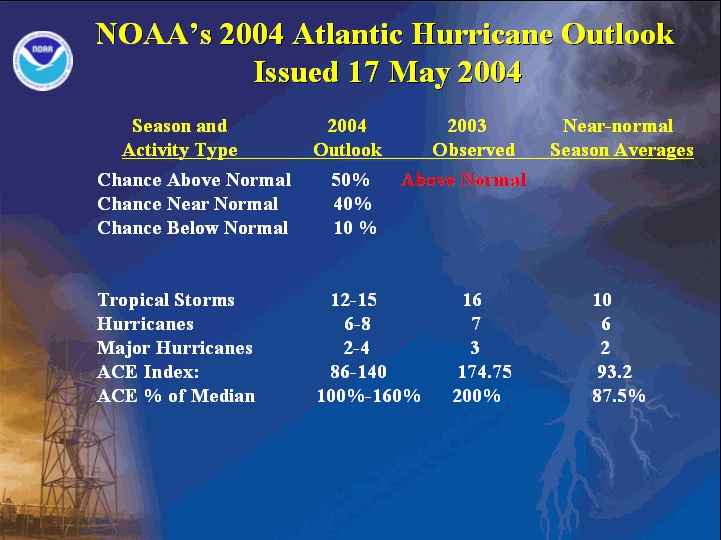
  • NOAA’s 2004 Atlantic hurricane season outlook indicates a 50% probability of an above-normal hurricane season, a 40% probability of a near-normal season, and a 10% chance of a below-normal season, according to a consensus of scientists at the National Oceanic and Atmospheric Administration’s (NOAA) Climate Prediction Center (CPC), the Hurricane Research Division (HRD), and the National Hurricane Center (NHC). See NOAA’s definitions of above-, near-, and below-normal seasons. The outlook calls for 12-15 tropical storms, with 6-8 becoming hurricanes, and 2-4 of these becoming major hurricanes. These numbers reflect a predicted ACE index in the range of 100%-160% of the median, and indicate a likely continuation of above-normal activity that began in 1995.
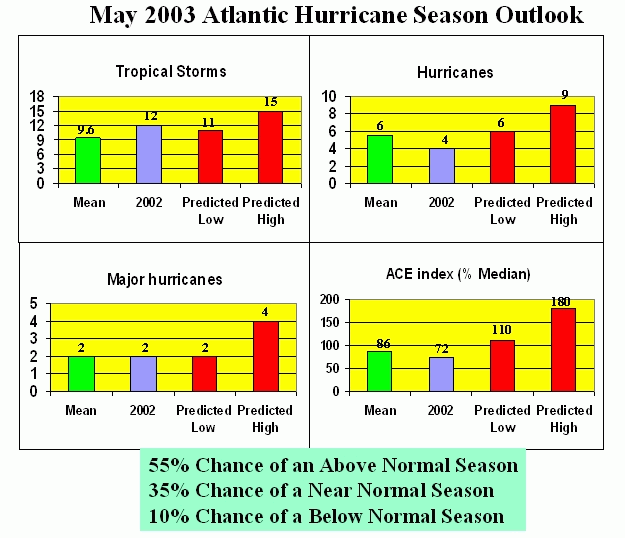
  • NOAA’s 2003 Atlantic hurricane season outlook indicates a 55% probability of an above-normal Atlantic hurricane season in 2003, a 35% probability of a near-normal season, and only a 10% chance of a below-normal season, according to a consensus of scientists at the National Oceanic and Atmospheric Administration’s (NOAA) Climate Prediction Center (CPC), the Hurricane Research Division (HRD), and the National Hurricane Center (NHC). See NOAA’s definitions of above-, near-, and below-normal seasons. The 2003 outlook calls for 11-15 tropical storms, with 6-9 becoming hurricanes, and 2-4 becoming major hurricanes.


The real question here the talking heads on TV ought to be asking is: “when haven’t they predicted an active season”? The answer? I do not know because the NOAA archives only go back to 1999 and only 2001 predicted a benign forecast of “normal to slightly above normal” hurricane activity. Every other year has featured an apocalyptic forecast. What do we as investors do then? This answer is easy, nothing. Meteorologists cannot even tell me with any significant accuracy if it is going to rain or not this weekend yet we are supposed to believe they can now predict a certain number of storms are going to form off the coast of Africa over 3,000 miles away and hit the states during the next 6 months? No way…..It is a fools bet. One also has to notice as they read the forecasts: “Why are they all basically the same?” 12-15 storms, 6-8 hurricanes, 2-4 majors. If every forecast is for the same number of storms, isn’t that then, “normal”?

But, what if they are right you ask? Well, if they are, there is nothing you can do about it so getting all worked up and trying to adjust your holdings now to reflect that is a lesson in futility. If you own stock in construction related companies (OC ), (SHW ), (HD ), (LOW ), you will benefit as repairs will boost sales. If you own USO and a storm hits the gulf, the increase in oil prices will benefit you. If oil goes up, ethanol companies like ADM benefit. If you own stocks in entertainment companies, you will suffer as this discretionary income will go toward other uses.

The really ugly truth is that hurricanes, unless they are Cat. 4 or 5 and cause massive damage to a major city and port like Katrina did, are not bad for the economy and actually provide a stimulus. After the brief interruption during and immediately after the storm, the rebuilding increases economic activity. When you have a slowing housing market and laborers out of work, nothing will put them back to work faster than a CAT-3 hurricane that damages 100,000 homes. No, I am not rooting for hurricanes and no, I am not hoping to profit from them, (though the ValuePlays Portfolio will) I just need to interject a little reality here to help you wade through the barrage of inane hysteria you are being assaulted with today.

What happens in the aftermath of a hurricane? Homes and businesses are damaged and /or destroyed and cleanup and repair then begins. Immediately federal and state funds flow into the area to clean up the mess providing additional jobs and money. Then, insurance proceeds come pouring in to add even more stimulus and jobs as residents try to rebuild thousands of homes and businesses at once . Of course there are areas of suffering and that cannot be avoided, but in the aggregate, there is a significant economic stimulus to the area for years to come.

The bottom line is that it has become painfully apparent we are always going to get a forecast that is for “above normal” hurricane activity. Worrying about it or trying to adjust your portfolio for this presumed alleged event in April is a colossal waste of time.

The phrase “to cry wolf“, derived from the fable, refers to the act of persistently raising the alarm about a non-existent threat, with the implication that the person who cried wolf would not be taken seriously should a real emergency take place. It can also be used to describe an alarm system that regularly goes off falsely, causing it not to be believed when a real emergency occurs.

Forecasters beware…

Categories
Articles

Dow Chemical (DOW): Looking Back To See The Future

I had promised to break down and comment further on Dow Chemical’s (DOW) CEO Andrew Liveris’s letter to shareholders a week ago and now that the Altria spin is over and I have been able to clear out my inbox with Altria (MO) related emails, it’s time to comment. These letters are very important if for no other reason it allows us to discern what is important to the person at the top and, are they managing the company in a way that directs it towards them. I read these for the same reason I read the Earning Call Transcripts on Seeking Alpha, numbers only tell you so much. Because of this, I will dispense with most of the sales and revenue numbers and deal with what is important to us. This is a great letter because he first reviews the goals he set in 2006, updates his progress towards them and then after proving that he is good to his word, lays out the future for Dow.

When I bought and recommended Dow I did so because they were doing 3 key (among other) very shareholder friendly things: increasing dividend, decreasing debt, share buybacks.

From the Letter:
“We reduced debt by $1.2 billion, lowering our Company’s debt-to-capital ratio from 39% in 2005 to 34% by year-end 2006. Today, our Company’s financial position is as strong as it has ever been. We also raised our dividend by 12% and repurchased more than 18 million shares, and our repurchase program is continuing. In October, we announced an additional $2 billion share buy-back program.”So far Liveris is delivering on his fiscal goals and the additional share repurchases show this will not subside in 2007. Now let’s look at some of the goals he set for the various businesses in 2006 and see what progress was made. From the letter:

Setting Public Goals
Early in 2006, we put some public stakes in the ground regarding our future plans. We said then that we would remain a diversified, integrated, global company, and we think our 2006 results bear out the wisdom of that statement. To bolster our Performance portfolio, we said we would launch two to four more market-facing businesses—businesses that focus on our most promising markets and bring the full power of our Company’s capabilities to them. We also said that we would make bolt-on acquisitions to support them. With that in mind, let’s examine what we did in our Performance portfolio.

  • We launched our new Dow Water Solutions market-facing unit, which offers world-class brands and technologies to the water treatment industry. With Dow’s existing technologies and the July acquisition of Zhejiang Omex Environmental Engineering in China, this platform advances our capabilities in desalination, water purification, contaminant removal and water recycling.
  • We also started up a new plant in the United States for the production of FILMTECTM membranes, substantially increasing the production capacity of our reverse osmosis membranes used in water treatment.
  • In Dow AgroSciences, we doubled capacity for our canola and sunflower oil seeds, affirming our growth strategy in the healthy oils sector.
  • In our Building Solutions unit, we expanded our capacity to produce
  • STYROFOAMTM brand insulation, and we added a new composite product for decking that is superior to wood in durability and maintenance.
  • In Greater China—where our sales increased from $2.3 billion to $2.7billion—we committed to the construction of a new glycol ethers plant, as well as a $200 million investment in our epoxy business for new manufacturing capacity and a new epoxy R&D center. And we began construction of our major new technology center in Shanghai.
  • In our Water Soluble Polymers business, we launched a new line of dietaryfiber products that help combat the problems of excessive blood glucose,cholesterol and insulin, as well as obesity. We also announced the planned acquisition of Bayer’s cellulosics business, which would increase the sales of our Water Soluble Polymers business by more than 60 percent to roughly $1 billion a year.With the Basics portfolio, as with our Performance portfolio, we will continue to take aggressive action throughout 2007, including new business models that will make our Basics portfolio more “asset light” and more competitive for the long term.

Revitalizing Innovation
Dow has a long history of strong innovation, and in 2006 we added some exciting new chapters to our story. And here let me note that we have been silent for a few years in order to avoid the trap of “overpromising and underdelivering.” So, rather than focusing on a handful of rifleshot projects, we announced that we are funding more than 600 projects that either strengthen our position in key franchises or break into entirely new areas of technology. These projects have a potential yield of $2 billion in additional EBIT by 2011. We intend to talk about all of these projects as they approach commercialization, and we will explain them in the context of broad themes. Three themes we launched in 2006 include:

  • In alternative feedstocks, we are pursuing the use of methane as a raw material to manufacture basic building blocks like ethylene and propyleneand to use natural oils, from soybeans for example, as raw materials for polyolplastics. Done on a broad scale, these alternative raw materials would significantly reduce the cost of our feedstocks.
  • In healthcare and nutrition, we are concentrating on projects such as Dow Agro Sciences’ healthy oils, and a new ingredient delivery system for medicines that uses water-soluble films.
  • In building and construction, with its renewed emphasis on energy conservation and a focus on eco-friendly building materials, we are working on projects ranging from the elimination of ozone-depleting blowing agents used in the manufacture of STYROFOAMTM brand insulation to new roofing systems that harness the sun’s energy at a much greater rate than current technology allows.


As I mentioned at the beginning of this letter, the surest method to increase the value of our Company to you, our investors, is to change our earnings profile. And to do that, we must draw a greater proportion of our earnings from Performance businesses.
So going forward, you can expect more of what you saw in 2006

  • More innovation
  • More market-facing businesses,
  • More asset-light joint ventures,
  • Continued financial strength and flexibility,


Finally Liveris writes:

“…we believe 2007 will be even more significant. We will continue to take action to transform the profile of our Company’s portfolio in order to change the profile of our earnings, including both strong growth (which we have historically achieved) and greater consistency (which, as a cyclical company, we have not).

The letter illustrates that Liveris is intent on moving Dow heavily into areas that demonstrate huge growth potential. If you have watched the news lately, several themes have been a constant:

  • Water, while plentiful in the US, is needed desperately in the rest of the world. Dow Water Solution has the inside edge and is addressing this need in China. This is severely overlooked by the mainstream media when talking about Dow.
  • Raw material costs. Dow is addressing this issue by finding and using bio solutions for production (natural oils in place of petroleum)
  • Asset-light ventures. These are the key. Why? It involves less investment which has the immediate effect of keeping debt levels low and increasing cash available for either further investment or being returned to shareholders. Another oft overlooked key is that these ventures allow both parties to maximize the strengths of each other. For instance, a new chemical plant in India allows Dow to take advantage of a much lower cost structure and the relations that the local company has in India to reduce production inputs while at the same time giving the Indian company access to Dow’s vast and experienced sales network and technical expertise. A win -win.
  • China, China, China. Dow has several very large projects there for chemicals that will directly address China’s ability to continue to grow, demand here will be huge.

Based on emails I have have been getting recently I was anticipating something to be announced by now. I would be VERY surprised if a major announcement was not made before April has ended and no, it will not involve a sale of the company. Assets, maybe, the whole company, no.

In this era of shareholder distrust of management, we shareholders of Dow are fortunate not to have that worry. Liveris has not done anything that should make us doubt his word or the direction he is taking the company. 1st quarter earnings will be webcast 4/26. I for one cannot wait.

When he says “2007 will be a significant year”, I believe him. You should to.

Categories
Articles

Altria (MO) : Spin Day and It’s Effect

So the much awaited and talked about the spin became official Friday and this morning both Kraft (KFT) and Altria (MO) began trading on their own. Lets take a look at the immediate effect on our holdings today.

As I stated in a earlier post, I advised MO holders to dump Kraft shares and purchase additional Altria shares. Let’s tale a look at the math to see how the spin has affect us. I will use the ValuePlays Portfolio to illustrate the effect. In the portfolio we have a purchase price of $88.06 per share. Now, as I have said before I have owned Altria shares for years but since I only started the blog in January and have no way of proving to you my true purchase price, my first post on the subject will have to be our purchase price. Based on the advice in my earlier post I immediately sold the Kraft and bough more Altria

This morning we got .69 shares of Kraft for each share of Altria we own. For simplicity sake, I am going to assume we only own 1 share. For this example in order to keep it as simple as possible and not get into partial shares and weighted average purchase price, I am going to assume we just sold our Kraft shares and are keeping the money in our account for now. Here is how it worked out.

Original Purchase Price of Altria: $88.06
Fridays Altria Closing Price: $87.81
Pre-spin Results: -.25 or .2%

Money received from sale of Kraft shares: $21.79 ($31.58 price X .69 shares)
New Adjusted Purchase Price of Altria: $66.27 ($88.06 – $21.79)

Current Altria Price: $67.80 (12 pm)
Post Spin Results: + $1.53 or +2.3%

Essentially, by dumping the Kraft shares that are down over 3% today at the open (which was also their high for the day) we have turned our investment in Altria from being just under water to up over 2%. Also, in 11 days we also get a dividend from Altria of 86 cents that at current prices adds another 1.3% to our gains. See Altria dividend information here.

Please do not get greedy and take these quick gains and run with the money. Hold your Altria shares because there is much more to come that will make you much more money in the end.

Categories
Articles

Most Read Posts in ValuePlays for March

Here are the most read stories for the month of March:

  1. The ValuePlays Portfolio
  2. Sherwin Williams- No Lead Threat
  3. Ethanol: Debunking A Few Myths
  4. Taking “A Leap”
  5. Housing: Enough Already!

Site traffic surged again this past month as subscribers rose 50% and daily traffic jumped 78% for the month (140% the past 2 weeks). Keep forwarding the daily email to family and friends and encourage them to sign up themselves, the more of us there are the better for all of us.

  • I have added an email link on the main page. Feel free to email me thoughts and ideas for stocks or general investing. I do not always get a chance to review the comments on a post and if you are commenting on something that was posted days ago, chances are I may not get to it. Enhanced Features Subscribers always get top priority but I will try to get to all of you. As the numbers of site visitors grow each day the delay here may become longer. Do yourself a favor, just buy the subscription for $6.99 a month and guarantee a fast reply. Think of it this way, if you had bought just 10 shares of each stock I recommended when I recommended it, you would have paid for 41 months of the subscription already. It really is a no brainer.
  • Criticism and /or complaints are welcome also just, keep them constructive. I can promise insulting or otherwise inappropriate emails to me or other “commenters” will be deleted immediately and the email address blocked. If you are so inclined to send one, make it a good one because it will be the last.
  • I am always looking for way to better the site and frequent visitors at times have noticed some odd things as I learn programing code “on the fly” as they say. Feel free to email any ideas to me. I cannot promise I will act on them but they will be considered. Any legitimate suggestion to better your experience on the site will get serious consideration.
  • Stock or investing ideas are welcome and may be used in a future post. For your privacy, your email address will not (unless you want it to be).

122,199

Categories
Articles

ValuePlays Portfolio- Update

Q1- 2007 (since 1/18/2007)

ValuePlays= +5.1%
S&P = -.6%

I have written about quite a few stocks here and have been asked by readers, “do you own all these stocks”? Well, no. I have put together an “Official Value Plays Portfolio” so you can track my suggestions and in turn, measure my results against others and the market as a whole. Just so everyone understands what the following chart means and how I am going to measure the results, here are the ground rules:

1- The “buy price” is the price the day I email Enhanced Features Members a “Trade Alert” that says “buy”. A post suggesting the same will hit the blog several days later giving EF Members ample time to buy ahead of others. Even though I have owned several of these picks for years, I cannot prove this to you so the date of the email will now be the “buy price”. For stocks we advise you avoid, we will track those by the price per share the day I recommend you avoid them.

2- Dividends, splits or spin offs will be treated as a reduction in the purchase price to show the “true return” on the investment. For example, I buy a stock for $20 and it pays a 25 cent quarterly dividend. Each quarter I will reflect that payment (gain) buy reducing our purchase price by 25 cents. That reduction will be noted in the “actual cost” category. This will be the same for the upcoming Kraft spin off by Altria, I will reflect the investment gain of the Kraft shares we receive (since I will not keep them) by reducing my purchase price for the Altria shares by the value of the Kraft shares. Should I change my mind and keep the shares, this will be reflected by a decrease in the purchase price of the Altria shares to reflect the gain and then a purchase of the Kraft shares in the same amount.These situations will be footnoted for individual explanation.

3- Should I recommend the purchase of additional shares of a security, that will be reflected by another entry for that security and that price (to assure consistency with the new post).

4- I update comments on results weekly to Enhanced Features Members and provide them more detailed information about the stocks in the portfolio (weekly and quartely #’s by their requests). The blog will receive periodic updates on securities. Since I am “long term” oriented, I will not break out results quarterly or annually on the blog. If you have read my posts, the conditions that will trigger a security to be sold will not be a temporary drop in the stock price, so monthly and quarterly results are essentially irrelevant. I have found that the shorter I make the tracking time frame of an investment, the more likely people are to make decisions based on short term events and not long term fundamentals. This is counter to my philosophy, so to help prevent that, all results will be “from inception”. By default since this is new, the initial results must be short term but as time goes on this will change. The benchmark I will use for comparison will be the S&P 500. It also will be tracked from the inception of my first post 1/18/2007.

5- I will rarely if ever “short” stocks (sell them first in the hopes of buying them back at a later date at a lower price). I will track the results of stocks I advise you avoid again in the interest of full disclosure and honesty.

6- I may engage in some options purchases or sales. If I do these will also be reflected on the tracking.

7- Portfolio assumes an equal weighting of shares for each security. By default this means I have more dollars invested in higher priced stocks like MO, and SHLD. I am very comfortable with this. Again, should we want to add additional shares of a security, we will note that by another entry.

8- Updates are current prices (20 min delay) through Google Finance.

Categories
Articles

Ethanol: Bet The Farm

Since the US crop report is coming out in 15 minutes this morning at 8:30 am, I though I should comment on it since I have been both an advocate and investor in renewable fuel for quite some time through Archer Daniels Midland (ADM). First things first, the crop report. Estimates for corn are an increase of 10 million acres for a total of 88 million acres being planted. My estimate is a minimum of 90 million acres. People for far too long have underestimated both the US farmer and the ethanol industries desire and ability to make ethanol a staple fuel source. Things begin to really change this summer. $4 a gallon gas will be reached and this will be the summer consumers finally have had enough and start to rise up in chorus to demand more ethanol at their pumps.

Currently ethanol is blended in 3% of gas in the US. We could up that number to 10% and need no modifications to any vehicle on the road. Million of people are driving E85 capable vehicles and are not even aware of it. My 2005 Suburban bought in Massachusetts for example, can run on E85 and I would be using it were it available. I would, and ever study done to date has confirmed that people would be willing to pay more for a home grown fuel than for gas from oil from the middle east.

The renewable fuels standard President bush signed in 2005 called for refiners to use 4.7 billions gallon of ethanol by the end of 2007 and it increases gradually to 7.4 billion gallon by 2012. Many ethanol critics use this as proof that were it not for the mandate, ethanol would not be used. To illustrate why this is false one must consider that in 2006, 4.8 billion gallons were produced for a demand of 5.3 billion gallons. Were the mandate the only reason for ethanol demand, these numbers would not exist. By the end of 2008 a minimum of 8 billion gallons will be available and no slackening in demand is seen. Why? Ethanol extends gas supplies and keeps the cost of gas down. Demand for E85 in the Midwest cannot be met. In short, famrers and the ethanol industry have made the “required standard” irrelevant.

Has there ever been a product that the majority of Americans wanted that business did not find a way to produce affordably and in quantites to satisfy them? I can’t think of any either….Do not ever bet against American ingenuity

Here are some more ethanol tidbits:

FACT: In 2005, the ethanol industry supported the creation of more than 153,725 jobs in all sectors of the U.S. economy, boosting U.S. household income by $5.7 billion.

Ethanol industry operations and spending for new construction added $1.9 billion of tax revenue for the Federal government and $1.6 billion for state and local governments. And the combination of spending for annual plant operations and capital spending for new plants under construction added more than $32.2 billion to gross output in the U.S. economy.

Source: Contribution of the U.S. Ethanol Industry to the Economy of the U.S. in 2005

FACT: By increasing the demand for corn, and thus raising corn prices, ethanol helps to lower federal farm program costs.

In 2004, USDA estimates ethanol production reduced farm program costs by $3.2 billion.

FACT: Ethanol refineries serve as local economic power houses. Click here for information on how a 50 and 100 million gallon ethanol refinery can benefit your community.

FACT: If ethanol were removed from the market, a shortfall would have to be made up from expensive imports.

Gasoline prices would increase 14.6% in the short term (36.5 cpg if gas is $2.50/gal). Prices would increase 3.7% in the long term (9.25 cpg if gas is $2.50/gal) even after refiners built new capacity or secured additional sources of supply.

Source: LECG, LLC, May 2004

FACT: The federal ethanol program generates revenue for the U.S. Treasury.

The federal ethanol incentive, which is available to gasoline marketers and oil companies (not ethanol producers) as an incentive to blend their gasoline with clean, domestic, renewable ethanol, is a cost-effective program. It actually returns more revenue to the U.S. Treasury than it costs, due to increased wages and taxes and reduced unemployment benefits and farm program payments, while at the same time holding down the price of gasoline and helping the American farmer.

The federal ethanol program was established following the OPEC oil embargoes of the 1970s, which exposed our dangerous dependence on imported oil. As an alternative to petroleum, ethanol directly displaces imported oil and reduces tailpipe emissions while helping to bolster the domestic economy. Yet today we import more petroleum than ever before. With rising crude oil prices and increasing international instability, incentives for production and use of domestic ethanol are critical.

We have subsidized the oil industry substantially since the early 1900s, and continue to do so. In fact, according to the General Accounting Office in an October 2000 report, the oil industry has received over $130 billion in tax incentives just in the past 30 years – dwarfing the roughly $11 billion provided for renewable fuels. During this time, U.S. oil production has fallen while annual U.S. ethanol production has grown dramatically.(GAO/RCED-00-301R)

FACT: In 2005, the use of ethanol reduced the U.S. trade deficit by $8.7 billion by eliminating the need to import 170 million barrels of oil.

Source: LECG, LLC January 2006

FACT: In 2005, the U.S. ethanol industry increased household income by $5.7 billion, money that flows directly into the pockets of American consumers.

Source: Contribution of the Ethanol Industry to the Economy of the U.S. in 2005

FACT: The U.S. ethanol industry has a proven track record of cost-effectively replacing MTBE and expanding gasoline supplies from coast to coast.

When California, New York and Connecticut switched from MTBE to ethanol in 2004, the transition went smoothly and both state and federal officials agree there was no negative impact on gasoline supplies or prices. The industry continues to expand and is prepared to assist any state confronting water quality issues or high gasoline prices.

Source: “Removing MTBE from Gasoline: Implications for the Northeast Gasoline Supply”

FACT: A modern dry-mill ethanol refinery produces approximately 2.8 gallons of ethanol and 17 pounds of highly valuable feed coproducts called distillers grains from one bushel of corn.

In 2005, ethanol dry mills produced approximately 9 million metric tons of distillers grains. Ethanol wet mills produced approximately 430,000 metric tons of corn gluten meal, 2.4 million metric tons of corn gluten feed and germ meal, and 565 million pounds of corn oil. The U.S. exports distillers dried grains with solubles mainly to Ireland, the UK, Europe, Mexico and Canada. Click here for more information on co-products.

FACT: Ethanol production does not reduce the amount of food available for human consumption.

Ethanol is produced from field corn fed to livestock, not sweet corn fed to humans. Importantly, ethanol production utilizes only the starch portion of the corn kernel, which is abundant and of low value. The remaining vitamins, minerals, protein and fiber are sold as high-value livestock feed.

An increasing amount of ethanol is produced from nontraditional feedstocks such as waste products from the beverage, food and forestry industries. In the very near future we will also produce ethanol from agricultural residues such as rice straw, sugar cane bagasse and corn stover, municipal solid waste, and energy crops such as switchgrass.

FACT: Most nations have an import tariff on fuel ethanol, and comparatively the U.S. tariff is nearly non-existent.

The U.S. ad valorem tariff is 2.5% of the product value, and is lower than any other country in the world. To prevent U.S. tax dollars from further subsidizing foreign-produced ethanol, which has already received support from the country of origin, there is a secondary duty of 14.27 cents per liter or 54 cents per gallon. The secondary duty was created to offset the value of the ethanol tax credit taken by the petroleum industry when ethanol, both domestic and imported, is blended with gasoline. As evident by the history of ethanol imports into the U.S., the secondary tariff is not a barrier to market entry.

There are exceptions to this rule. First, in some of our bilateral trade agreements like the U.S.-Israel Free Trade Agreement and the North American Free Trade Agreement, we allow ethanol that is fully produced with feedstocks from those countries to enter the U.S. duty-free.

Secondly, Congress has created some unilateral trade preference programs, such as the Caribbean Basin Initiative and the Andean Trade Preference Act that allow ethanol produced in those countries to enter the U.S. duty free. This means that ethanol producers in those countries avoid the secondary tariff as long as the ethanol is produced from within their own country. The purpose of this program is to encourage economic development in the Andean and Caribbean region, which helps fight poverty and drug trafficking. Notably, to date, these trade agreements and preference programs have not led to significant ethanol imports to the U.S.

Click here for more information on import tariffs and trade.