Categories
Articles

Looking at Case-Schiller Through Howard Hughes’ Eyes…

Categories
Articles

Is This Recovery Really “Different”?

"Davidson" submits:

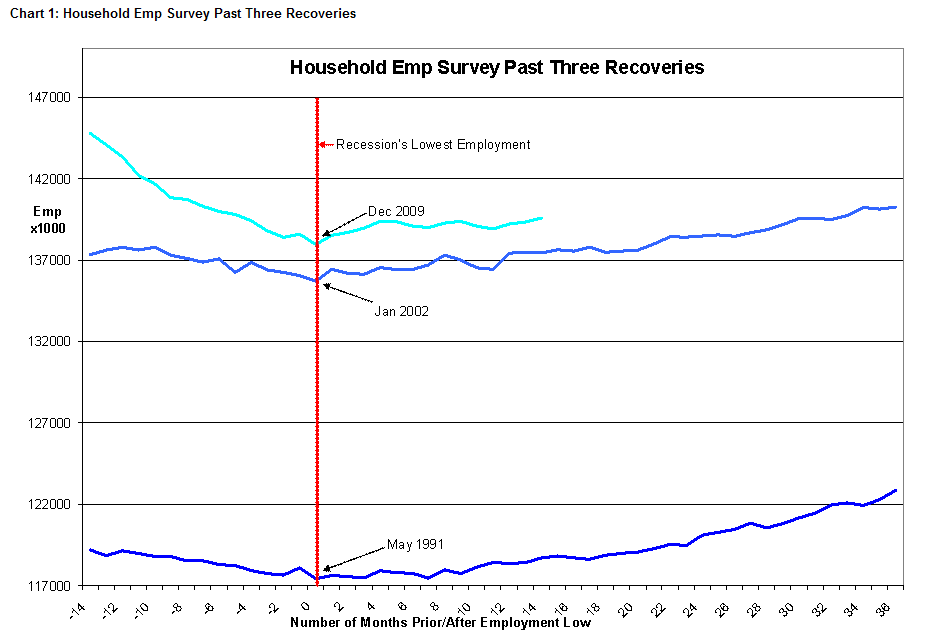
The media has presented many analysts who expressed views that “…this recovery is different” from past recoveries regarding employment. The study in Chart 1: Household Emp Survey Past Three Recoveries reveals that the current recovery is actually similar to the 2002 and 1991 recoveries regarding the comparable rate of employment recovery. One can see that the general trend of the month-to-month rate of change of the current recovery appears almost identical to that in 2002 and 1991.

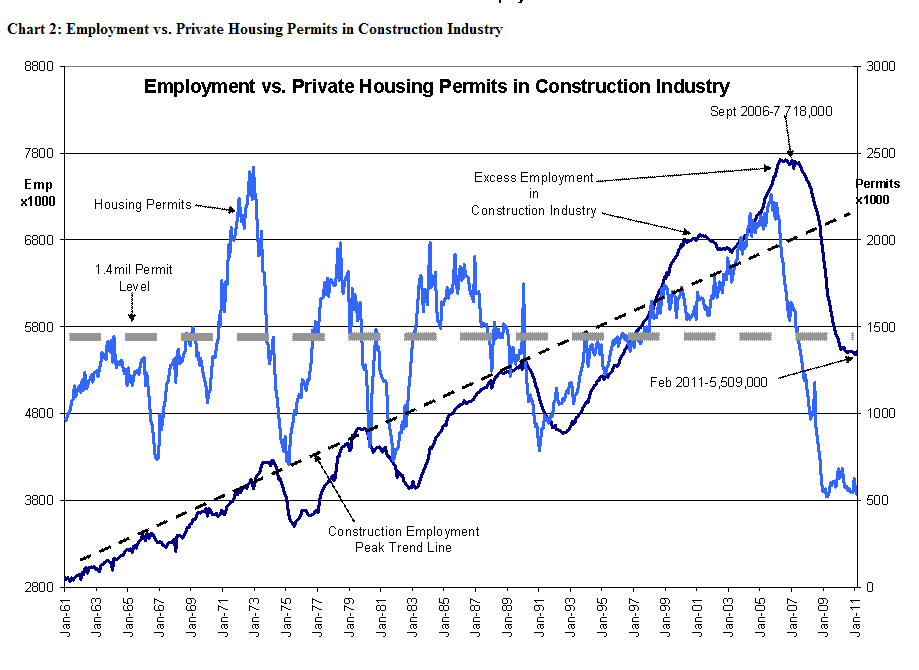
But, what was truly different this time was the stimulation provided by the Community Reinvestment Act of 1995. Government has a long history of providing support for homeownership for various social and political reasons. Periodically, since the early 1960s, there have been surges and declines in the numbers of private homes built reflecting a boom-bust cycle that has averaged ~1.4million new homes each year. See- Chart 2: Employment vs. Private Housing Permits in Construction Industry

Construction Employment (includes all construction residential, commercial and etc) has a defined trend from 1961-Present that one can draw connecting the peak levels of employment that follow the surge of issued housing permits. What should be clear in Chart 2 is that Construction Employment soared after the Community Reinvestment Act of 1995 as government pressed banks to lend to the less fortunate. Excess lending led to excess employment which was nearly 1million above the peak trend line in Sept 2006-Peak Trend Line level of ~6,800,000 vs. Construction Employment of 7,718,000. This created excess employment in associated industries as well. One of the features of the excess lending during the years leading to this peak was “Sub-Prime” lending which included lending for car and light truck purchases in the form of home equity loans. This was even before Sub-Prime homeowners had created any home equity!!

Excess within an economy is never limited solely to a single industry.

The excess Construction Employment of 2006 on correction resulted in layoffs of ~2.2mil individuals in construction alone (Sept 2006-7,718,000 fell to Feb 2011-5,509,000) which represented ~25% of the 8.4mil individuals laid off from 2006 to Dec 2009 as the recession gathered strength. With housing being one of the basic industries of the US economy, the devastation to employment rolls was widespread as even industries thought minimally connected proved not exempt. The economic excess that led to our recent recession in spite of the many denials by elected officials can be laid to the political desire to stimulate homeownership in my opinion.

Almost everyone in and out of government thought Sub-Prime lending was a wonderful idea as the results piled in one on top of another. Unfortunately the I.O.U. was mountainous!

Net/net, this recovery appears quite similar to previous recoveries.
Categories
Articles

Weekend Berkowitz and St. Joe Reading

Categories
Articles

US New Auto Sales Predicted Up 16% in March, Ford Leads….

Categories
Articles

Something Brewing at ACAS?

Categories
Articles

Rail Traffic Continues to Move in Right Direction

Categories
Articles

Dow Continues To Pay Down Debt

Categories
Articles

ASA Temp Staffing Climbs in March

Categories
Articles

Ford Sees “Little Impact” Due To Japan

Categories
Articles Video

Ford’s New Marketing Campaign

Categories
Articles

Rail Traffic Still Increasing

Categories
Articles

St. Joe Wins Important Court Decision

Forbes Reports:

A federal judge in Delaware has ordered a lawsuit by St. Joe Co. against Transocean over the Deepwater Horizon oil spill back to state court, raising the odds the drilling company will be dragged into litigation it was hoping to avoid.

The decision issued yesterday by U.S. District Judge Leonard P. Stark increases the risk Transocean will be held liable by a jury for some of the costs associated with the spill. If that happens, plaintiffs might assert that finding in the hundreds of cases now being consolidated in New Orleans.

“At that point the only discussion would be over damages,” said William Brewer of Bickel & Brewer, the Dallas law firm representing St. Joe in its unconventional strategy of concentrating on BP contractors instead of the British oil company itself. “This is a very significant development for St. Joe given the size of our claims.”

St. Joe is seeking more than $500 million for the diminished value of some 600,000 acres it is developing in Florida. The claim is based on the decline in St. Joe shares after the spill, which have since rebounded as 29% owner Fairholme Funds won a struggle for control of the firm. Its shares were unchanged midday Wednesday.

Here is the applicable verbiage from the court:

St. Joe Court Decision (click to open .pdf)

The Court agrees with St. Joe. In Askew v. American Waterways Operators, Inc., 411
u.s. 325,328 (1973), a pre-OPA opinion, the Supreme Court held that a Florida statutory scheme regarding oil spill damages was not preempted by federal law. The Court explained:

One can read the history ofthe Admiralty Extension Act without finding any clear indication that Congress intended that sea-to-shore injuries be exclusively triable in the federal courts ….

[S]ea-to-shore pollution -historically within the reach ofthe police power ofthe States -is not silently taken away from the States by the Admiralty Extension Act, which does not purport to supply the exclusive remedy ….

. . .. But we decline to … oust state law from any situation involving shoreside injuries by ships on navigable waters. The Admiralty Extension Act does not pre-empt state law in those situations.

So, what does it mean? St. Joe’s lawsuit is likely headed for Florida State Court and a Florida jury, not to be lumped together in Louisiana with thousands of other suits. My bet would be it never sees a jury and Transocean will eventually enter into a closed settlement.  Anything JOE gets from this will be a huge plus.

On the other hand, for those involved in the spill, this is very unwelcome news. Large class action are always better as they consolidate claims and decrease the eventual value of them all. If this begins to spill out into local state courts, things for all defendants will get very ugly rather quickly.

Categories
Articles

An Interesting Matter in JC Penny’s Proxy

Categories
Articles Video

ValuePlays TV 3/15/2011

Categories
Articles

Orion’s Value Proposition