Categories
Articles

AutoNation: "Cash for Clunkers" Should Add 10%

I think 10% may be a bit conservative. From the empirical evidence department. I know several folks who are eagerly looking into the “cash for clunkers” program’s details to get a new car. These are folks who have been putting off buying a new car for the past year and a half not wanting a new car payment. But, the advertised incentives, coupled with the age of their current vehicles, has them taking a very close look at this.

From Bloomberg:

– AutoNation Inc. said the “cash-for- clunkers” law President Barack Obama signed may increase new- vehicle sales at the largest publicly traded U.S. auto retailer by 10 percent through year end.

AutoNation sold 65,698 new vehicles in the third quarter of last year through its 289 dealer franchises. A 10 percent increase from the law approved yesterday may mean “roughly” an extra 4,000 new vehicles because industry demand has been running as much as 40 percent lower than last year, according to Marc Cannon, a company spokesman.

“The fact that this incentive will be available only at new-vehicle franchises is a big advantage,” Chief Executive Officer Mike Jackson said in an interview. “At a minimum it will generate a lot of traffic.”

Knowing Jackson, my guess is that 10% is “in the bag” so to speak and he is looking for much more. In the past he has said about other statements of this order, “if we weren’t sure we could do it, we wouldn’t say it”, and to this point, he has yet to let investors down on that.

No reason to expect him to start now…


Disclosure (“none” means no position):Long AN

Categories
Articles

Wall St. Media 6/24

Sorry for the lag on this…getting used to the “new baby” schedule…

Doug and I here are talking about my initial thoughts on Saks (SKS), more on natural gas (UNG) and General Growth Properties (GGWPQ) .

Catch more great investing video at Wall St. Media


Disclosure (“none” means no position):Long SKS, UNG, GGWPQ

Categories
Articles

Monday’s Links

Bernanke, Porn, Rules, RMBS

– Great WSJ piece on him. Ben is going to take the fall for everything. He does not deserve as he was handed a huge shit pile from Greenspan.

– This is a bad idea….it is hard enough to keep it away from kids w/o Johnny putting it up on the school bus on his iPhone.

– “4 Investing Rules to Ignore”. Morningstar does a good job here

– S&P finally downgrading these…..finding it hard to believe this was not done last year


Disclosure (“none” means no position):

Categories
Articles

Anon Bidder Ponies Up $1.68M For Lunch With Warren

I am sure there are a bunch of jokes as to who coming until we actually know the bidder….

Visit msnbc.com for Breaking News, World News, and News about the Economy


Disclosure (“none” means no position):

Categories
Articles

"House of Cards"

Personally, I think Faber does a nice job on this one. Wondering how the whole thing started and came tumbling down? Check it out…

Greenie gets off a bit easy though…


Disclosure (“none” means no position):

Categories
Articles

Buy and Hold Dead? Um…No

Been hearing this a ton lately. Problem with the statement is it taking a blanket approach and doing that in anything, is wrong. Those who typically espouse it say that the S&P 500 has done a round trip over the past decade so those who “bought it” have made no money. But, do most of us “buy the S&P”? No one I know does.

I’m going to take a look at the longest holding I ever had…Altria (sold last December).

I bought it in late 1999 in the midst of the “Master Settlement” and Chapter 11 fears for them. The buying thesis was simple:

1- Addicts will buy their products
2- They can’t go Chapter 11 because those suing them (States) need the money they provide
3- Because of that, their long term health was assured.

The purchase price for Alria was $21.65 a share and when I sold it was $16.75. In addition to that I received $21 a share in the Kraft (KFT) spin-off (sold immediately), $48 a share in Phillip Morris International (PM) shares (still held and today worth $42).

Oh, and over the 9 years I held it I received $23.25 a share in dividends.

Here is a 10-yr. chart of Altria.
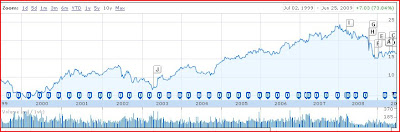
Now the temptation would have been to dump it in 2003 as it fell and then even again in 2004 as it dipped. But why? Just because the price fell?

Questions to have asked yourself then:

  • Were the fundamentals of the tobacco business impaired?
  • Did the legal environment deteriorate?
  • Did management do something that changed the earnings profile of the company in a negative way?

The answer to all of those questions was no and in reality the legal environment improved steadily in those years to the point then CEO Camilleri said prior to the PM spin, “the current legal environment is the best we have seen it in years”.

So in 9 years here is the tally:

That is a 18% annual return over those 9 years for doing…….nothing…

A very similar scenario has unfolded with McDonalds (MCD) since I first bought during the “Mad Cow” scare. While not as extreme, and I did make the HUGE mistake of selling Chipolte (CMG) shares when I received them in the spin, it has been a fantastic investment.

Has the market done a round trip the past decade? Yes. Are there plenty of companies whom over that time have gone up/down and then back to start? Yes. BUT, if you buy it low enough and pay attention to its business environment/prospects to determine your selling time, you can avoid many of the losses.

Altria’s business environment never deteriorated over the 9 years and in fact dramatically improved over where it was at purchase. I sold it in December because I felt that changed and PM International has a superior one. The same can be said of McDonalds, it environment is still improving with its very successful move into coffee and consumer trade to value.

Have it missed any? Sure. Dow Chemical (DOW) comes to mind. I got caught up in the Rohm & Hass/Kuwait deals and their potential benefits while the surrounding business climate deteriorated. The stock fell to a low of $6 from $50’s in 2005 (my original cost was $26 in 2002). While I lost a bunch of unrealized profits, between $8 and $9 in March of this year I was able to lower my cost basis to $14 with several purchases. Again, when we add in $9.32 in dividends received since 2002, we are still up nicely, although not nearly as much as before..not nearly.

Am I selling Dow now? No. The Rohm deal is done and the business environment, while I missed the downside, looks to improve going forward. This will still turn out just fine eventually IMO, it will just take some time. We’ll see…

Beware of “X investing theory is dead” proclamations. There are plenty of value folks who do great, plenty of day traders who do great and plenty of swing/momentum ones that do. There are also plenty of all three that do awful.

Find good ones in the style that fits you and get to know them. Blogs & twitter allow unprescedented communications between investors, take advantage of it.


Disclosure (“none” means no position):Long PM, MCD, DOW, none

Categories
Articles

Phillip Morris International to Return $9B in ’09

Received Phillip Morris International (PM) shares from Altria in last years spinoff. Due to the deteriorating US legal environment for tobacco recently, I sold my long time holding Altria (MO) in December and now only still hold PM shares.

I consider PM the company of the two with better longer term prospects and business environment.

One overlooked investment thesis for PM is that it is a hedge against the general devaluation of the US dollar. PM sells tobacco in other nations in their local currencies, it then convert those currencies to US dollars for reporting purposes. As the dollar falls in value, those conversions yield more dollars for shareholders.

For those who do not want to go through the whole presentation, slide 67 is the applicable slide. The comments were:

In August last year, we raised our dividend by 17.4% to an annualized rate of $2.16 per share and we have confirmed our willingness to exceed our target 65% dividend payout ratio in 2009. At the current stock price, our dividend provides an attractive yield of approximately 5.2%.

We have completed over half the $13 billion two year share repurchase program that we initiated in May 2008 and are one of the few major companies in the world to have maintained their share repurchase program throughout the current financial crisis.

All in all we expect to return some $9 billion in cash to our shareholders during 2009.

So we have a 5% dividend yield and a company growing earnings 10-12% annually. Based on that earnings growth, we should see a dividend next year or $2.43 a share for a current yield of 5.7%. PM did say they may consider exceeding that (65% of earnings) this year which would boost it higher.

Phillip Morris International


Disclosure (“none” means no position):Long PM

Categories
Articles

Friday’s Links

Railroads, Frank, Onion, Google

– Bolling seconds my railroads call.

– Actually wants to lower lending standards for Condo’s. Apparently has been asleep the last two years?

Another classic

– Sell ads on mobile phones

Disclosure (“none” means no position):

Categories
Articles

Notes on Buffett’s Media Tour

Berkshire’s (BRK.A) made the rounds yesterday. Some of his comments:

For those not sure Berkshire is intimately tied to the consumer through its Shaw Carpets, American Express (AXP), Dairy Queen, Home Services (real estate brokerage), furniture companies, banks and more. Because of that, Berkshire is uniquely sensitive to all sectors of the economy. So, when Buffett says he is seeing little improvement, it is something we all need to pay attention to. Quote may not be 100% accurate verbally but are for sentiment. For instance, “we” rather than “us” etc….meaning of quotes intact.

“We are setting the stage for VERY SIGNIFICANT inflation down the road”

On US Dollar: “probability of significant purchasing power decline has risen dramatically”

US AAA Rating: “the US will keep it as long as I and you (Liz Claymen) are alive and longer”

Unemployment: “it is going higher, we are not coming off the bottom yet”..

Obama’s health care reform: “malpractice premiums are 1/2 of 1% of what we (the US) spend on health care each year”

Regulation: “the wrong regulation would be one that attempts to solves evils and stifles the markets system that has worked pretty well over the years”

Acknowledged he is sitting on a $1 billion profit from his Goldman Sachs (GS) investment and said he will “keep the warrants for their duration”

On the de-leveraging process for consumers and corporate America “there is a lot still to do”

“Economy will be in shambles this year and well beyond”

“you can’t produce a baby in 1 month by getting 9 women pregnant”. Meaning we can’t turn the economy around in a couple months, it is a long process and gov’t officials would be wise to acknowledge this.

Should Ben Bernanke be given another term?: “I don’t know how you could do any better”

“The incentives in a market system are too overshoot” and he gave the impression he was relatively sure it would happen again some day.

“I do not worry about deflation a all and we will not see any serious deflation….”

On Gov’t TARP funds & Wells Fargo (WFC) “the gov’t set the terms, they (WFC) just signed a blank piece of paper”

On Steve Jobs “if any CEO is facing serious surgery, it is a material event”

Cap and Trade: “is a regressive tax”


Disclosure (“none” means no position):Long WFC, None

Categories
Articles

Why Competition Matters: Apple & RIMM

Here is a very interesting smart-phone study that primarily deals with Apple’s (AAPL) iPhone and RIMM’s (RIMM) Blackberry. This has nothing to do with value investing although it does show how tech margins always compress when a hot products sees competition.

Crowd Science Smart Phone Results

So, if you are RIMM seeing this study you have two options:
1- Lower your blackberry prices to capture value conscious buyers
2- Dramatically improve the add-on availability and functionality of the social aspects of your product.

Either of those options will cost RIMM and benefit users of their products. Apple users are very loyal no matter what the product. RIMM has very little chance of altering that barring an earth shattering product. Their choice is to now keep their users and entice those entering the smart-phone market to buy theirs over Apple’s.

With Apple lowering the price of its 3G 16GB phone to $147 in Wal-Mart (WMT), (down from the original $599 8GB price only just over two years ago), consumers ought to see even better deals in the future.

How long before a 32GB 4G phone hits the shelves for $99? Another year? RIMM needs to so something fast. Now, I discount the “loyalty” part of the equation for the Apple folks. They were this way about the company before the iPhone. What matters more here is the number of “other smart-phone” users considering buying an iPhone with their next purchase.
That means defections for RIMM and other makers. It also means they are probably busying themselves finding ways to bend over backwards to give users “a deal they cannot resist”. RIMM did drop prices last year and was very successful capturing value conscious shoppers. Apple followed suit and based on RIMM most recent earnings call, that drop looks to be having an effect on RIMM going forward.

What does it all mean then? Look for more applications, better & faster phones and lower prices going forward….

Capitalism at its finest..


Disclosure (“none” means no position):Blackberry user, none in stocks

Categories
Articles

Thursday’s Links

Bing, Predictions, China, Banks

– It just keeps growing. Good, more options make those that are available improve them

– Sorry but this end of the world stuff just does not wash. While we may stagnate for a good long time until we work through this, doomsday predictions will not come true. Also, any economic prediction of 10 or 20 years time frames is not worth the paper you print it on.

– Actively lowering its cost of oil

– This is a startling chart and shows how far US banks nave fallen


Disclosure (“none” means no position):

Categories
Articles

Warren Buffett Makes the Rounds Today…

Berkshire’s (BRK.A) Buffett was everywhere today. Saying this was a “cautious” interview session would be understated..

On Bloomberg

On Fox talking Economy & Inflation
On Fox talking Unemployment
On CNBC talking the Economy


Disclosure (“none” means no position):

Categories
Articles

More "Green" Possibilites?

The other day we looked at railroads and their “green” impact. Today we look in another direction.

From the NY Times:

Dow Chemical & Gazprom recently signed a memorandum in which they agreed to look at opportunities where Dow technologies could be used to reduce carbon emissions, thus generating the emission credits. The companies agreed to look at opportunities worldwide.

Dow could then use some of the credits to offset its own industrial activities while Gazprom’s trading arm in Britain could market any excess.

In other words, by using Dow technologies, companies can generate carbon credits that they can then sell or use as currency to offset the purchase of the technology.

Additionally:

However, the true promise for this business is in carbon credits that come, like the gas, from Russia. Companies in Russia and elsewhere in Eastern Europe are among the world’s big producers of greenhouse gases. But they stand to benefit under the climate treaty by selling their rights to release carbon dioxide into the air, if they invest in greater efficiencies.

The statement said the companies would also explore projects in the small carbon market in the United States.

As a country, Russia possesses the credits in abundance under the Kyoto Protocol, which set a baseline in 1990 for emissions, before a sharp contraction in the Russian economy greatly reduced carbon emissions. Russia can transfer those benefits to its companies to sell.

In 2004, when Russia ratified the protocol, officials estimated Russian companies could earn $6 billion to $9 billion selling credits created from investments in emissions-reducing technologies.

Now, lets put aside that the largest polluters will benefit the most from the cap/trade program because of the 1990 baseline. Is it wrong? Yes. A joke? Yes. But, it is what it is and wishing it wasn’t won’t change anything.

Cap/Trade is shaping up to be a massive market. Personally, I’ll avoid anything in Russia as their recent history of respecting property rights is poor to say the least. However, if you have the stomach for it, the potential for nice profits is there as a large additional revenue stream will appear for those Russian companies. That being said, companies that have the technologies polluters (for lack of a better word) will want to generate the credits will be in high demand.

Why? Using a baseline of 1990 when Russian /Eastern Europe were coming out from a century of Communist rule means that even token upgrades ought to generate huge credits. In all reality many operating facilities probably now already produce less than 1990 levels of pollutants so the impetus to “do something” to qualify for large numbers of credits will assuredly be there. That assures demand for products.

It also means that the potential impact of cap/trade on some industrial companies may not be as great as originally thought as the products they produce may offset the emissions they produce. They may not realize the full potential profits from the sales of these products as credits may be used as currency, but the downside is reduced. Sadly, companies whose products do not lower emissions will pick up the tab for the rest.

A company like Dow looks to benefit as their products will be used by Gazprom and US energy companies to lower their emissions. The credits generated can be used by Dow to reduce their own emissions tab. Again, everything depends on base levels, requirements etc. but that is the basic theory. Other possible beneficiaries could be GE (GE) and BASF (among others) who make emission control systems.

Again, until final legislation/treaties are signed and finalized, making investments here is guesswork. But, seeing that the market will be huge and knowing early entrants into markets tend to benefit the most, it is time to begin looking into possibilities.


Disclosure (“none” means no position):Long DOW, GE, none

Categories
Articles

ESL Files 13D/A in AutoZone

Lampert and ESL files 13D/A in Autozone (AZO)

Lampert 13D/A in Autozone


Disclosure (“none” means no position):

Categories
Articles

“Breaking the Bank” Merrill & Bank of America

Frontline does it again….watching this though….does anyone else get the impression both Thain from Merrill (MER) and B of A’s (BAC) Lewis are….well…..”truth challenged”?


Disclosure (“none” means no position):None